Today's
EarthStation1.com 15% Off Commemorative Memorial Title: Tolstoy
from Riches to Rags: Leo Tolstoy Biography DVD, MP4, USB Drive
Today, November 15, 2025
November 15: National Philanthropy Day:
-- National Philanthropy Day honors those who give back to their
communities. The word philanthropy comes from Latin and Greek
philanthropia which gives us kindliness, humanity, and love for
mankind. From this, we take the philo (tending to, fond of) and
join antropos meaning mankind or human beings. Philanthropists
give of their time and money in ways that provide a lasting
impact: Supports education through scholarships, grants,
foundations, and more; Foundations support scientific research;
Development of charities; Funding grants to programs for local,
national, and international needs; Encourage art through grants
and foundations; Invest in advocacy platforms for the
underprivileged. The day recognizes philanthropists for their many
significant contributions, help, and good deeds and for the
differences that they have made in our lives and our communities.
While philanthropy is giving and kind, it is a type of gift that
strives to replace social ills with solutions. Philanthropists see
issues and try to solve them. Charity often is a temporary
solution for a temporary problem. When the issue persists, we seek
a cure. There are instances of philanthropy that can overlap with
instances of charity. The difference is that charity relieves the
pains of social problems, whereas philanthropy attempts to solve
those problems at their root causes. Learn more about the kinds of
philanthropy in your community. Read books on the history of
philanthropy in the United States. You can also: Share how
philanthropy has impacted your community; Support your favorite
philanthropic organization; Volunteer for a local organization;
Share your favorite organization's page and your favorite
projects; and use #NationalPhilanthropyDay to post on social
media! The Association of Fundraising Professionals created
National Philanthropy Day in 1985. On Sale @ 15% Off Discount Till
Midnight PT!
https://store.earthstation1.com/tolstoy-from-riches-to-rags-dvd.html
Today's
EarthStation1.com 15% Off Commemorative Memorial Title: Walt
Whitman Documentary Biography DVD, Video Download, USB Drive
Today, November 15, 2025
November 15: I Love To Write Day: --
Writing is a form of communication that's been around since the
very beginning, and lots of people love to do it. It's one of the
most magical ways of sharing your ideas with the world. I Love to
Write Day was started by an author called John Riddle, from
Delaware. He wanted a day set aside so that everyone, no matter
their age, could spend some time writing. It doesn't matter what
people write, as long as they write what they want to. John Riddle
was a writer, he wrote over 34 books and tons of articles. He
believes that writing is a very good way for people to express
themselves creatively. So he decided to challenge people to set
one day aside for writing. He believed that I Love to Write Day
could launch the careers of the next bestselling author, as long
as they sit down and write! Writers across the world write on all
sorts of topics, in many different forms. There are fictional and
non-fictional books, novels, short stories, poems, plays, essays,
articles, songs, and scripts. They may write for themselves, for
blogs, for newspapers, or be working with publishing houses. Some
writers may also be illustrators or work with illustrators to add
pictures to their books. A lot of writers are self-taught,
although many might choose to improve their skills by taking a
short course, or even a full degree in the kind of writing they
want to pursue. There are courses journalists, bloggers, and
creative writers of all kinds. Writers are needed everywhere
because a good writer is one who can convey ideas clearly. So even
if you're a scientist, you still need to be a good writer if you
want to talk about your research! On Sale @ 15% Off Discount Till
Midnight PT!
https://store.earthstation1.com/walt-whitman-dvd-biography-poetry-documentary.html
Today's
EarthStation1.com 15% Off Commemorative Memorial Title: The Incas
Remembered: Historical Documentary DVD, MP4, USB Stick
Today, November 15, 2025
November 15, 1533: The Spanish
Colonization Of The Americas: Indigenous Rebellions In Mexico And
Central America: The Spanish Conquest Of The Inca Empire (The
Conquest Of Peru): -- The Spanish seal the Conquest Of Peru when
Francisco Pizarro arrives in Cuzco, the capital of the Inca
Empire, located in the fertile Mantaro Valley, Pizarro advanced
into Cuzco with his army of 500 Spaniards accompanied by
Chalcuchimac, one of the leading Inca generals of the north and a
supporter of Atahualpa, who was subsequently burned at the stake.
During the exploration of Cuzco, Pizarro was impressed and through
his officers wrote back to King Charles I of Spain, saying: "This
city is the greatest and the finest ever seen in this country or
anywhere in the Indies... We can assure your Majesty that it is so
beautiful and has such fine buildings that it would be remarkable
even in Spain." Jauja was established as Peru's provisional
capital in April 1534, but it was high up in the mountains and too
distant from the sea to serve as the capital. Pizarro founded the
city of Lima on Peru's central coast on January 6, 1535, which he
considered to be one of the most important things he had created
in life. After the final effort of the Inca to recover Cuzco had
been defeated by Almagro, a dispute occurred between Pizarro and
Almagro respecting the limits of their jurisdiction, as both
claimed the city of Cuzco. The King Of Spain had awarded the
Governorate of New Toledo to Almagro and the Governorate of New
Castile to Pizarro. The dispute had originated from a disagreement
on how to interpret the limit between the governorates. This led
to confrontations between the Pizarro brothers and Almagro, who
was eventually defeated during the Battle of Las Salinas (1538)
and executed. Almagro's son, also named Diego and known as El
Mozo, was later stripped of his lands and left bankrupt by
Pizarro. In Lima, on 26 June 1541 "a group of 20 heavily
armed supporters of Diego de Almagro II "el mozo"
stormed Pizarro's palace, assassinating him and then forcing the
terrified city council to appoint young Almagro as the new
governor of Peru", according to Burkholder and Johnson. "Most
of Pizarro's guests fled, but a few fought the intruders, numbered
variously between seven and 25. While Pizarro struggled to buckle
on his breastplate, his defenders, including his half-brother
Martin de Alcantara, were killed". For his part, Pizarro
killed two attackers and ran through a third. While trying to pull
out his sword, he was stabbed in the throat, then fell to the
floor where he was stabbed many times." Pizarro (who now was
maybe as old as 70 years and at least 62), collapsed on the floor,
alone, painted a cross in his own blood and cried for Jesus
Christ. He died moments after. Diego de Almagro the younger was
caught and executed the following year after losing the battle of
Chupas. Pizarro's remains were briefly interred in the cathedral
courtyard; at some later time, his head and body were separated
and buried in separate boxes underneath the floor of the
cathedral. In 1892, in preparation for the anniversary of
Columbus' discovery of the Americas, a body believed to be that of
Pizarro was exhumed and put on display in a glass coffin. However,
in 1977, men working on the cathedral's foundation discovered a
lead box in a sealed niche, which bore the inscription "Here
is the head of Don Francisco Pizarro Demarkes, Don Francisco
Pizarro who discovered Peru and presented it to the crown of
Castile." A team of forensic scientists from the United
States, led by William R. Maples, was invited to examine the two
bodies and they soon determined that the body which had been
honored in the glass case for nearly a century had been
incorrectly identified. The skull within the lead box not only
bore the marks of multiple sword blows, but the features bore a
remarkable resemblance to portraits made of the man in life. The
Spanish Conquest Of The Inca Empire, also known as Conquest Of
Peru, was one of the most important campaigns in the Spanish
colonization of the Americas. After years of preliminary
exploration and military skirmishes, 168 Spanish soldiers under
conquistador Francisco Pizarro, his brothers, and their native
allies captured the Sapa Inca Atahualpa in the 1532 Battle of
Cajamarca. It was the first step in a long campaign that took
decades of fighting but ended in Spanish victory in 1572 and
colonization of the region as the Viceroyalty of Peru. The
conquest of the Inca Empire (called "Tahuantinsuyu" or
"Tawantinsuyu" in Quechua, meaning "Realm of the
Four Parts"), led to spin-off campaigns into present-day
Chile and Colombia, as well as expeditions towards the Amazon
Basin. On Sale @ 15% Off Discount Till Midnight PT!
https://store.earthstation1.com/the-incas-remembered-historical-documentary-dvd-mp4-us4.html
Today's
EarthStation1.com 15% Off Commemorative Memorial Title: American
Revolutionary War Documentaries DVD, Download, USB Drive
Today, November 15, 2025
November 15, 1777: The Age Of
Enlightenment (The Enlightenment, The Age Of Reason): The Age Of
Revolution: The Atlantic Revolutions: The American Enlightenment:
The American Revolution: The Continental Congress: The Second
Continental Congress: The Articles Of Confederation: -- The Second
Continental Congress of the original 13 states of the United
States of America approves The Articles Of Confederation for
ratification by the states, after much debate that had lasted
since the signing of The Declaration Of Independence over a year
earlier in July 1776. The Articles Of Confederation only came into
full force once it was ratified by all 13 states over three years
later on March 1, 1781, Congress nevertheless began immediately to
operate under the Articles' terms once they approved the articles,
and it produced the immediate result one month later of obtaining
France's formal recognition of the United States on December 17,
1777. On Sale @ 15% Off Discount Till Midnight PT!
https://store.earthstation1.com/american-revolutionary-war-dvd-documentaries.html
Today's
EarthStation1.com 15% Off Commemorative Memorial Title: The
Divided Union: American Civil War TV Series MP4 Download DVD Set
Today, November 15, 2025
November 15, 1864: November 11, 1864: The
American Civil War (The Civil War, The War Between The States):
The Eastern Theater Of The American Civil War: The Atlanta
Campaign: The Fall Of Atlanta: Sherman's March To The Sea (The
Savannah Campaign, Sherman's March): The Burning Of Atlanta: --
Union General William Tecumseh Sherman burns Atlanta and starts
Sherman's March To The Sea. The city of Atlanta, Georgia, in
Fulton County, was an important rail and commercial center during
the American Civil War. Although relatively small in population,
the city became a critical point of contention during the Atlanta
Campaign in 1864 when a powerful Union Army approached from
Union-held Tennessee. The Fall Of Atlanta was a critical point in
the Civil War, giving the North more confidence, and (along with
the victories at Mobile Bay and Winchester) leading to the
re-election of President Abraham Lincoln and the eventual
surrender of the Confederacy. The capture of the "Gate City
of the South" was especially important for Lincoln as he was
in a contentious election campaign against the Democratic opponent
George B. McClellan. On Sale @ 15% Off Discount Till Midnight PT!
https://store.earthstation1.com/the-divided-union-american-civil-war-tv-series-3-dual-layer-dvd3.html
Today's
EarthStation1.com 15% Off Commemorative Memorial Title: Labor
Union Films Collection DVD, Video Download, USB Flash Drive
Today, November 15, 2025
November 15, 1881: Organized Labor: The Labor Union Movement: The Labor Union Movement In The United States: The Labor History Of The United States: Labor Unions In The United States: -- The Federation Of Organized Trades And Labor Unions Of The United States And Canada was formed at Turner Hall in Pittsburgh, Pennsylvania; five years later the organization was renamed the American Federation Of Labor (AFL). During the Long Depression of 1873-1878, the Knights Of Labor emerged as a potent force for workers in the United States. But as Marxists and Socialists joined the labor movement and fought for dominance within various labor unions, influential newspapers began to advocate for the suppression of trade unions. Many in the American labor movement, such as Samuel Gompers, sought to implement a 'New Unionism' program which would free unions from political affiliation and limit their goals to the day-to-day concerns of working people. On Sale @ 15% Off Discount Till Midnight PT! https://store.earthstation1.com/labor-union-films-dvd.html
Today's
EarthStation1.com 15% Off Commemorative Memorial Title: Erwin
Rommel Documentaries Set DVD, Video Download, USB Flash Drive
Today, November 15, 2025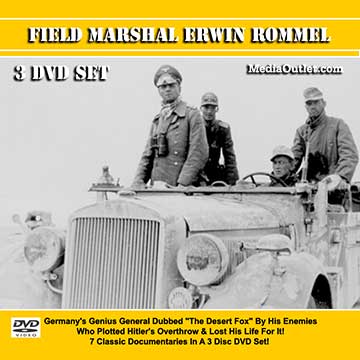
November 15, 1891: #BOTD: Erwin Rommel,
German General, Field Marshal and military theorist (d. October
14, 1944) is #born Johannes Erwin Eugen Rommel at Heidenheim, in
Wurttemberg, Germany. Popularly known as the Desert Fox, he served
as field marshal in the Wehrmacht (armed forces) of Nazi Germany
during World War II, as well as serving in the Reichswehr of the
Weimar Republic, and the army of Imperial Germany. Rommel was a
highly decorated officer in World War I and was awarded the Pour
le Merite, Germany's highest military award,for his actions on the
Italian Front. In 1937 he published his classic book on military
tactics, Infantry Attacks, drawing on his experiences in that war.
In World War II, he distinguished himself as the commander of the
7th Panzer Division during the 1940 Battle Of France. His early
victories and leadership of German and Italian forces in the North
African campaign established his reputation as one of the ablest
tank commanders of the war, and earned him the nickname der
Wustenfuchs, "the Desert Fox". However, in 1943, he was
defeated at El Alamein by the British under General Montgomery.
Among his British adversaries he had a reputation for chivalry,
and his phrase "war without hate" has been used to
describe the North African campaign. A number of historians have
since rejected the phrase as myth and uncovered numerous examples
of war crimes and abuses both towards enemy soldiers and native
populations in Africa during the conflict. Other historians note
that there is no clear evidence Rommel was involved or aware of
these crimes (although Caron and Mullner point out that his
military successes allowed these crimes to happen) with some
pointing out that the war in the desert, as fought by Rommel and
his opponents, still came as close to a clean fight as there was
in World War II. He later commanded the German forces opposing the
Allied cross-channel invasion of Normandy in June 1944. A number
of historians connect Rommel himself with war crimes, although
this is not the opinion of the majority. With the Nazis gaining
power in Germany, Rommel gradually came to accept the new regime,
with historians giving different accounts on the specific period
and his motivations. He is generally considered a supporter and
close friend of Adolf Hitler, at least until near the end of the
war, if not necessarily sympathetic to the party and the
paramilitary forces associated with it. His stance towards Nazi
ideology and his level of knowledge of the Holocaust remain
matters of debate among scholars. In 1944, Rommel was implicated
in the failed 20 July plot to assassinate Hitler. Because of
Rommel's status as a national hero, Hitler desired to eliminate
him quietly instead of immediately executing him, as many other
plotters were. Rommel was given a choice between committing
suicide, in return for assurances that his reputation would remain
intact and that his family would not be persecuted following his
death, or facing a trial that would result in his disgrace and
execution; he chose the former and on October 14, 1944 committed
suicide at age 52 near Ulm, Germany using a cyanide pill. Rommel
was given a state funeral, and it was announced that he had
succumbed to his injuries from the strafing of his staff car in
Normandy. He is buried at the Friedhof Herrlingen in Herrlingen,
Baden-Wurttemberg, Germany. Rommel has become a larger-than-life
figure in both Allied and Nazi propaganda, and in postwar popular
culture, with numerous authors considering him an apolitical,
brilliant commander and a victim of the Third Reich, although this
assessment is contested by other authors as the Rommel myth.
Rommel's reputation for conducting a clean war was used in the
interest of the West German rearmament and reconciliation between
the former enemies - the United Kingdom and the United States on
one side and the new Federal Republic of Germany on the other.
Several of Rommel's former subordinates, notably his Chief Of
Staff Hans Speidel, played key roles in German rearmament and
integration into NATO in the postwar era. The German Army's
largest military base, the Field Marshal Rommel Barracks,
Augustdorf, is named in his honour. On Sale @ 15% Off Discount
Till Midnight PT!
https://store.earthstation1.com/rommel-dvd-field-marshal-erwin-dual-layer-wwii-documentaries.html
Today's
EarthStation1.com 15% Off Commemorative Memorial Title: JFK, Hoffa
& The Mob: Lawyer Frank Ragano Confessions DVD, MP4, USB
Today, November 15, 2025
November 15, 1914: #BOTD: Santo
Trafficante Jr., one of the most powerful Mafia bosses in the
United States (d. March 17, 1987) is #born in Tampa, Florida, to
Sicilian parents Santo Trafficante Sr. and his wife Maria Giuseppa
Cacciatore. He headed the Trafficante crime family and controlled
organized criminal operations in Florida and Cuba, which had
previously been consolidated from several rival gangs by his
father, Santo Trafficante Sr. Trafficante maintained links to the
Bonanno crime family in New York City, but was more closely allied
with Sam Giancana in Chicago. Consequently, while generally
recognized as the most powerful organized crime figure in Florida
throughout much of the 20th century, Trafficante was not believed
to have total control over Miami, Miami Beach, Ft. Lauderdale, or
Palm Beach. The east coast of Florida was a loosely knit
conglomerate of New York family interests with links to Meyer
Lansky, Bugsy Siegel, Angelo Bruno, Carlos Marcello, and mob
lawyer Frank Ragano. Trafficante admitted his anti-Castro
activities to the United States House Select Committee on
Assassinations in 1978, and vehemently denied allegations that he
had knowledge of a plot to assassinate President John F. Kennedy.
Frank Ragano alleges that both of these statements are false.
Ragano states that Trafficante admitted to him that he lied to the
House Assassinations committee about his anti-Castro activities,
given him by the CIA to perform these activities but that he did
nothing of the kind; and he asserts that Trafficante confessed to
him shortly before he died that he, Carlos Marcello and Jimmy
Hoffa had arranged for the assassination of President John F.
Kennedy in 1963. These Kennedy assassination conspiracy theories
have been called into question by others. Federal investigators
brought racketeering and conspiracy charges against Trafficante in
summer of 1986, and Trafficante retained Ragano as his lawyer to
defend against these charges. Santo Trafficante Jr.died at the age
of 72 at the Texas Heart Institute in Houston, Texas where he had
gone for heart surgery. He is buried at The L'Unione Italiana
Cemetery in Ybor City, Florida. On Sale @ 15% Off Discount Till
Midnight PT!
https://store.earthstation1.com/jfk-hoffa-amp-the-mob-lawyer-frank-ragano-confessions-dvd-mp4-us4.html
Today's
EarthStation1.com 15% Off Commemorative Memorial Title: The Eyes
Of War: The Interwar Period 1918-1939 DVD, MP4, USB Drive
Today, November 15, 2025
November 15, 1920: Grand Openings:
International Organizations (Intergovernmental Organizations,
International Institutions): The League Of Nations (LN, LON, LoN,
(French: Societe Des Nations, "Society Of Nations", SDN,
SdN): -- The first assembly of the The League Of Nations, the
first worldwide intergovernmental organisation whose principal
mission was to maintain world peace, is held in the Palais Wilson
(French: Wilson Palace) in Geneva, Switzerland. The League Of
Nations was founded on January 10, 1920 following the Paris Peace
Conference that ended the First World War; in 1919 US President
Woodrow Wilson was to win the Nobel Peace Prize for his role as
the leading architect of the league.The organisation's primary
goals, as stated in its Covenant, included preventing wars through
collective security and disarmament and settling international
disputes through negotiation and arbitration. Other issues in this
and related treaties included labour conditions, just treatment of
native inhabitants, human and drug trafficking, the arms trade,
global health, prisoners of war, and protection of minorities in
Europe. The Covenant of the League Of Nations was signed on June
28, 1919 as Part I of the Treaty Of Versailles, and it became
effective together with the rest of the Treaty on January 10,
1920. The first meeting of the Council of the League took place on
January 16, 1920, and the first meeting of Assembly of the League
took place on November 15, 1920. The diplomatic philosophy behind
the League represented a fundamental shift from the preceding
hundred years. The League lacked its own armed force and depended
on the victorious First World War Allies (France, the United
Kingdom, Italy and Japan were the permanent members of the
Executive Council) to enforce its resolutions, keep to its
economic sanctions, or provide an army when needed. The Great
Powers were often reluctant to do so. Sanctions could hurt League
members, so they were reluctant to comply with them. During the
Second Italo-Abyssinian War, when the League accused Italian
soldiers of targeting Red Cross medical tents, Benito Mussolini
responded that "the League is very well when sparrows shout,
but no good at all when eagles fall out." At its greatest
extent from September 28, 1934 to February 23, 1935, it had 58
members. After some notable successes and some early failures in
the 1920s, the League ultimately proved incapable of preventing
aggression by the Axis powers in the 1930s. The credibility of the
organization was weakened by the fact that the United States never
joined the League and the Soviet Union joined late and was soon
expelled after invading Finland. Germany withdrew from the League,
as did Japan, Italy, Spain and others. The onset of the Second
World War showed that the League had failed its primary purpose,
which was to prevent any future world war. The League lasted for
26 years; the United Nations (UN) replaced it after the end of the
Second World War and inherited several agencies and organisations
founded by the League. On Sale @ 15% Off Discount Till Midnight
PT!
https://store.earthstation1.com/the-eyes-of-war-the-interwar-period-19181939--dv191819394.html
Today's
EarthStation1.com 15% Off Commemorative Memorial Title: Radio
Broadcasting History Films DVD, Video Download, USB Flash Drive
Today, November 15, 2025
November 15, 1926: Grand Openings:
Broadcasting: The History Of Broadcasting: Radio: The History Of
Radio Broadcasting: -- The NBC radio network opens with 24
stations. RCA spent 1M USD to purchase WEAF and Washington sister
station WCAP, shut down the latter station, and merged its
facilities with surviving station WRC; in late 1926, RCA announced
the creation of its new division, the National Broadcasting
Company. This division's ownership was split among RCA (a majority
partner at 50%), its founding corporate parent General Electric
(which owned 30%) and Westinghouse (which owned the remaining
20%). New York City's WEAF, the former flagship of Western
Electric, and Newark, New Jersey's WJZ, the flagship Westinghouse,
were operated side-by-side for about a year as part of the new
NBC. On January 1, 1927, NBC formally divided their respective
marketing strategies: the "Red Network" offered
commercially sponsored entertainment and music programming, with
WEAF as its flagship, and the "Blue Network" mostly
carried sustaining - or non-sponsored - broadcasts, especially
news and cultural programs, with WJZ as its flagship. Various
histories of NBC suggest the color designations for the two
networks came from the color of the pushpins NBC engineers used to
designate affiliate stations of WEAF (red) and WJZ (blue), or from
the use of double-ended red and blue colored pencils. On Sale @
15% Off Discount Till Midnight PT!
https://store.earthstation1.com/radio-broadcasting-history-films-2-dvd-se2.html
Today's
EarthStation1.com 15% Off Commemorative Memorial Title: WWII
Films: The Asia-Pacific War DVD, Video Download, USB Flash Drive
Today, November 15, 2025
( #JCKaelin here: EarthStation1
MediaOutlet is located a mere 7 blocks directly north of the New
Jersey entrance of this bridge, and it dominates the sky when
looking south of here during the winter months when the big old
trees have shed their leaves ;) .) ========= November 15, 1931:
Grand Openings: Bridge Openings: New York City (New York, NYC):
Bridges And Tunnels In New York City: Suspension Bridges:
Suspension Arch Bridges: The Bayonne Bridge: -- The Bayonne
Bridge, the world's longest suspended arch bridge, and the world's
longest steel arch bridge at that time, connecting Bayonne, New
Jersey and Staten Island, New York City, first opens. Patterned on
the Hell Gate bridge a few miles northeast, its sister bridge is
the the Sydney Harbour Bridge. All of the nearly 400 Elco class PT
boats used during World War II, including one under the command of
U.S. Navy lieutenant John F. Kennedy, the future president of the
United States, were manufactured under its shadow, and performed
their test runs under it. Today, EarthStation1 Multimedia is based
at the New Jersey foot of that bridge. The Bayonne Bridge features
prominently in Elco's 1944 film "Giant Killers" about
the PT boats they built and tested under this bridge. On Sale @
15% Off Discount Till Midnight PT!
https://store.earthstation1.com/wwii-films-the-asiapacific-conflict-dvd.html
Today's
EarthStation1.com 15% Off Commemorative Memorial Title: The Secret
War Historic WWII TV Series + Bonus Title DVD MP4 USB Drive
Today, November 15, 2025
November 14-15, 1940: The European Civil
War: World War II: The Second European War (The European Theater
Of World War II): Aviation: Military Aviation: Air Warfare Of
World War II: The Battle of Britain: Strategic Bombing During
World War II: European Air Operations During The Battle Of Europe:
The Blitz: The Coventry Blitz (The Coventration): -- The city of
Coventry, England is heavily bombed by 515 German Luftwaffe
bombers from Luftflotte 3 and from the pathfinders of Kampfgruppe
100 during the overnight of November 14-15. Coventry Cathedral is
almost completely destroyed. The Coventry Blitz (blitz: from the
German word Blitzkrieg meaning "lightning war") was a
series of bombing raids that took place on the English city of
Coventry. The city was bombed many times during the Second World
War by the German Air Force (Luftwaffe). The most devastating of
these attacks occurred on the evening of November 14, 1940 and
continued into the morning of November 15. In one night, more than
4,300 homes in Coventry were destroyed and around two-thirds of
the city's buildings were damaged. The raid was heavily
concentrated on the city centre, most of which was destroyed. Two
hospitals, two churches and a police station were also damaged.
The local police force lost no fewer than nine constables or
messengers in the blitz. Approximately one third of the city's
factories were completely destroyed or severely damaged, another
third were badly damaged, and the rest suffered slight damage.
Among the destroyed factories were the main Daimler factory, the
Humber Hillman factory, the Alfred Herbert Ltd machine tool works,
nine aircraft factories, and two naval ordnance stores. However,
the effects on war production were only temporary, as much
essential war production had already been moved to 'shadow
factories' on the city outskirts. Also, many of the damaged
factories were quickly repaired and had recovered to full
production within a few months. An estimated 568 people were
killed in the raid (the exact figure was never precisely
confirmed), with another 863 badly injured and 393 sustaining
lesser injuries. Given the intensity of the raid, casualties were
limited by the fact that a large number of Coventrians "trekked"
out of the city at night to sleep in nearby towns or villages
following the earlier air raids. Also, people who took to air raid
shelters suffered very little death or injury. Out of 79 public
air raid shelters holding 33,000 people, very few had been
destroyed. The attack, code-named Operation Mondscheinsonate
(German: Operation Moonlight Sonata), inflicted considerable
damage to monuments and residential areas. The initial wave of 13
specially modified Heinkel He 111 aircraft of Kampfgruppe 100,
which were equipped with X-Gerat (German: X-Device) navigational
devices, accurately dropped navigational marker flares at 19:20.
The British and the Germans were fighting the Battle of the Beams
and on this night the British failed to disrupt the X-Gerat
signals. The Battle of the Beams was a period early in the Second
World War when bombers of the German Air Force (Luftwaffe) used a
number of increasingly accurate systems of radio navigation for
night bombing in the United Kingdom. British scientific
intelligence at the Air Ministry fought back with a variety of
their own increasingly effective means, involving jamming and
distortion of the radio waves. The period ended when the Wehrmacht
moved their forces to the East in May 1941, in preparation for the
attack on the Soviet Union. The first wave of follow-up bombers
dropped high explosive bombs, knocking out the utilities (the
water supply, electricity network, telephones and gas mains) and
cratering the roads, making it difficult for the fire engines to
reach fires started by the later waves of bombers. These later
waves dropped a combination of high explosive and incendiary
bombs. There were two types of incendiary bomb: Those made of
magnesium and those made of petroleum. The high explosive bombs
and the larger air-mines not only hindered the Coventry fire
brigade, they were also intended to damage roofs, making it easier
for the incendiary bombs to fall into buildings and ignite them.
Coventry's air defences consisted of twenty-four 3.7 inch AA guns
and twelve 40 mm Bofors. The AA Defence Commander of 95th
(Birmingham) Heavy Anti-Aircraft Regiment, Royal Artillery, had
prepared a series of concentrations to be fired using
sound-locators and GL Mk. I gun-laying radar, and 128
concentrations were fired before the bombing severed all lines of
communication and the noise drowned out sound-location. The
anti-aircraft batteries then fought on in isolation. Some gun
positions were able to fire at searchlight beam intersections,
glimpsed through the smoke and guessing the range. Although the
Coventry guns fired 10 rounds a minute for the whole 10 hour raid
(a total of over 6,700 rounds), only one German bomber was shot
down. At around 20:00, Coventry Cathedral (dedicated to Saint
Michael), was set on fire by incendiaries for the first time. The
volunteer firefighters managed to put out the first fire but other
direct hits followed and soon new fires broke out in the
cathedral; accelerated by a firestorm, the flames quickly spread
out of control. During the same period, more than 200 other fires
were started across the city, most of which were concentrated in
the city-centre area, setting the area ablaze and overwhelming the
firefighters. The telephone network was crippled, hampering the
fire service's command and control and making it difficult to send
firefighters to the most dangerous blazes first; as the Germans
had intended, the water mains were damaged by high explosives,
meaning there was not enough water available to tackle many of the
fires. The raid reached its climax around midnight with the final
all clear sounding at 06:15 on the morning of November 15.
Although the city centre suffered the heaviest raids, districts of
the city including Stoke Heath, Foleshill and Wyken were also
heavily bombed. The raid reached such a new and severe level of
destruction that Joseph Goebbels later used the term coventriert
("coventried") when describing similar levels of
destruction of other enemy towns. During the raid, the Germans
dropped about 500 tonnes of high explosives, including 50
parachute air-mines, of which 20 were incendiary petroleum mines,
and 36,000 incendiary bombs. The raid of November 14, combined
several innovations which influenced all future strategic bomber
raids during the war. These were: 1) The use of pathfinder
aircraft with electronic aids to navigate, to mark the targets
before the main bomber raid; and 2) The use of high explosive
bombs and air-mines (blockbuster bombs) coupled with thousands of
incendiary bombs intended to set the city ablaze in a firestorm.
In the Allied raids later in the war, 500 or more heavy
four-engine bombers all delivered their 3,000-6,000-pound
(1,400-2,700 kg) bomb loads in a concentrated wave lasting only a
few minutes. But at Coventry, the German twin-engined bombers
carried smaller bomb loads (2,000-4,000 pounds (910-1,810 kg)),
and attacked in smaller multiple waves. Each bomber flew several
sorties over the target, returning to base in France to rearm.
Thus the attack was spread over several hours, and there were
lulls in the raid when firefighters and rescuers could reorganise
and evacuate civilians. As Arthur Harris, commander of RAF Bomber
Command, wrote after the war: "Coventry was adequately
concentrated in point of space [to start a firestorm], but all the
same there was little concentration in point of time." The
British used the opportunity given them by the attack on Coventry
to try a new tactic against Germany, which was carried out on
December 16, 1940 as part of Operation Abigail Rachel against
Mannheim. The British had been waiting for the opportunity to
experiment with an incendiary-intensive raid, considering it a
kind of retaliation for the German raid on Coventry. This was the
start of a British drift away from precision attacks on military
targets and towards area bombing attacks on whole cities. On Sale
@ 15% Off Discount Till Midnight PT!
https://store.earthstation1.com/the-secret-war-wwii-weaponry-tv-series-all-7-episodes-2-dv72.html
Today's
EarthStation1.com 15% Off Commemorative Memorial Title: Victory At
Sea (1954) Rare WWII Movie DVD, MP4 Download, USB Stick
Today, November 15, 2025
November 15, 1942: World War II: The
Pacific War (The Asia-Pacific War, The Asiatic-Pacific Theater,
The Pacific Theater Of World War II): The Pacific Ocean Theater Of
World War II: The South West Pacific Area (SWPA): Operation
Cartwheel: The Solomon Islands Campaign: The Battle Of Guadalcanal
(The Guadalcanal Campaign, Operation Watchtower): The Naval Battle
Of Guadalcanal (The Third And Fourth Battles Of Savo Island, The
Battle Of The Solomons, The Battle Of Friday the 13th, The Night
Of The Big Guns, The Third Battle Of The Solomon Sea): -- The
Naval Battle Of Guadalcanal, the decisive engagement in a series
of naval battles between Allied (primarily American) and Imperial
Japanese forces during the months-long Guadalcanal campaign in the
Solomon Islands, ends in a decisive Allied victory. The
Guadalcanal Campaign, also known as the Battle Of Guadalcanal and
codenamed Operation Watchtower was a military campaign fought
between August 7, 1942 and February 9, 1943 on and around the
island of Guadalcanal in the Pacific theater of World War II. It
was the first major offensive by Allied forces against the Empire
Of Japan. On August 7, 1942, Allied forces, predominantly United
States Marines, landed on the islands of Guadalcanal, Tulagi, and
Florida in the southern Solomon Islands, with the objective of
denying their use by the Japanese to threaten Allied supply and
communication routes between the US, Australia, and New Zealand.
The Allies also intended to use Guadalcanal and Tulagi as bases to
support a campaign to eventually capture or neutralize the major
Japanese base at Rabaul on New Britain. The Allies overwhelmed the
outnumbered Japanese defenders, who had occupied the islands since
May 1942, and captured Tulagi and Florida, as well as an airfield
(later named Henderson Field) that was under construction on
Guadalcanal. Powerful American and Australian naval forces
supported the landings. Surprised by the Allied offensive, the
Japanese made several attempts between August and November to
retake Henderson Field. Three major land battles, seven large
naval battles (five nighttime surface actions and two carrier
battles), and continual (almost daily) aerial battles, culminated
in the decisive Naval Battle Of Guadalcanal in early November, in
which the last Japanese attempt to bombard Henderson Field from
the sea and land with enough troops to retake it was defeated. In
December, the Japanese abandoned their efforts to retake
Guadalcanal and evacuated their remaining forces by February 7,
1943, in the face of an offensive by the US Army's XIV Corps. The
Guadalcanal campaign was a significant strategic combined arms
Allied victory in the Pacific theater. Along with the Battle of
Midway, it has been called a turning point in the war against
Japan. The Japanese had reached the peak of their conquests in the
Pacific. The victories at Milne Bay, Buna-Gona, and Guadalcanal
marked the Allied transition from defensive operations to the
strategic initiative in the theater, leading to offensive
operations such as the Solomon Islands, New Guinea, and Central
Pacific campaigns, that eventually resulted in Japan's surrender
and the end of World War II. On Sale @ 15% Off Discount Till
Midnight PT!
https://store.earthstation1.com/victory-at-sea-1954-dvd-the-movie-rare-wwii-1954.html
Today's
EarthStation1.com 15% Off Commemorative Memorial Title: Auschwitz
And The Allies 2 Part TV Series DVD, Download, USB Drive
Today, November 15, 2025
November 15, 1943: The European Civil
War: World War II: The Second European War (The European Theater
Of World War II): The Holocaust (Shoah): The Romani Holocaust (The
Romani Genocide, The Porajmos [Romani: "The Devouring"],
The Samudaripen [Romani: "The Mass Killing"])" --
Heinrich Himmler orders that all Gypsies and part-Gypsies be put
"on the same level as Jews and placed in concentration
camps"; the number of Gypsies killed by Nazis is estimated up
to 500,000. The Romani Holocaust was the effort by Nazi Germany
and its World War II allies to commit ethnic cleansing and
eventually genocide against Europe's Romani people (including the
Sinti) during the Holocaust era. Under Adolf Hitler, a
supplementary decree to the Nuremberg Laws was issued on 26
November 1935, classifying the Romani as "enemies of the
race-based state", thereby placing them in the same category
as the Jews. Thus, the fate of the Roma in Europe paralleled that
of the Jews in the Holocaust. Historians estimate that between
250,000 and 500,000 Romani and Sinti were killed by Germans and
their collaborators-25% to over 50% of the estimate of slightly
fewer than 1 million Roma in Europe at the time. Later research
cited by Ian Hancock estimated the death toll to be at about 1.5
million out of an estimated 2 million Roma. In 1982, West Germany
formally recognized that Germany had committed genocide against
the Romani. In 2011, Poland officially adopted August 2 as a day
of commemoration of the Romani genocide; the date was chosen for
the memorial because on the night of August 2-3 ,1944, 2,897 Roma,
mostly women, children and elderly people were killed in the Gypsy
family camp (Zigeunerfamilienlager) in Section B-IIe of the
Auschwitz II-Birkenau Concentration Camp of Auschwitz
Concentration Camp. Within the Nazi state, first persecution, then
extermination, was aimed primarily at stationary "Gypsy
mongrels". Starting in February 1943, a majority of the Roma
living in the German Reich were deported to the specially
established Gypsy camp at Auschwitz. Other Roma were deported
there from the occupied Western European territories. Only a
minority survived. Outside the reach of systematic registration,
as in the German-occupied areas of Eastern Europe and Southeastern
Europe, the Roma who were most threatened were those who, in the
German judgment, were "vagabonds", though some were
actually refugees or displaced persons. Here, the members of the
minority fell victim above all to massacres by German military and
police formations, as well as to the SS task forces and the fight
against armed resistance to the German occupation. On Sale @ 15%
Off Discount Till Midnight PT!
https://store.earthstation1.com/auschwitz-and-the-allies-dvd-complete-2-part-tv-serie2.html
Today's
EarthStation1.com 15% Off Commemorative Memorial Title: LBJ 1991
TV Documentary Series Lyndon Johnson DVD Download USB Drive
Today, November 15, 2025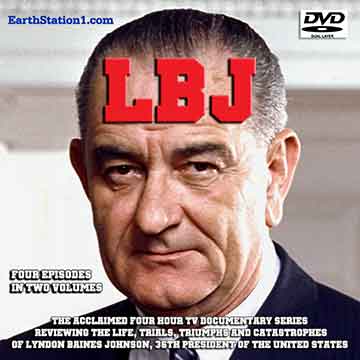
November 15, 1969: The Aftermath Of World
War II: The Cold War: The Cold War In Asia: The Indochina Wars:
The Vietnam War (The Second Indochina War, The Vietnam Conflict,
The Resistance War Against America): The United States In The
Vietnam War: Opposition To United States Involvement In The
Vietnam War: The Moratorium To End The War In Vietnam: The March
Against Death (The Moratorium March): -- Having begun on the
evening of Thursday, November 13, the largest antiwar rally in
U.S. History, between 250,000 and 500,000 anti-war protesters
peacefully demonstrate with the conclusion of their Moratorium
March with their symbolic March Against Death in Washington, D.C.
on Saturday, November 15, 1969. The Moratorium To End The War In
Vietnam was a massive demonstration and teach-in across the United
States against the United States involvement in the Vietnam War.
It took place on October 15, 1969, followed a month later, on
November 15, 1969, by a large Moratorium March in Washington,
D.C.. It marks the moment that the anti-war movement became a
full-fledged mass movement. By the time that weekend was over,
Washington, D.C., had seen more protesters than any single event
in its history had drawn; attendance was higher, by tens of
thousands, than at the 1963 Civil Rights March On Washington. And
despite a name that, 45 years later, may seem overblown or vague,
the march was actually about something very specific. The deaths
they were protesting were those of soldiers and civilians in
Vietnam. As TIME reported in the Nov. 21, 1969, issue:
"Disciplined in organization, friendly in mood, [the march]
started at Arlington National Cemetery, went past the front of the
White House and on to the west side of the Capitol. Walking single
file and grouped by states, the protesters carried devotional
candles and 24-in. by 8-in. cardboard signs, each bearing the name
of a man killed in action or a Vietnamese village destroyed by the
war. The candles flickering in the wind, the funereal rolling of
drums, the hush over most of the line of march-but above all, the
endless recitation of names of dead servicemen and gutted villages
as each marcher passed the White House -were impressive drama:
"Jay Dee Richter"... "Milford Togazzini"...
"Vinh Linh, North Viet Nam"... "Joseph Y. Ramirez."
At the Capitol, each sign was solemnly deposited in one of several
coffins, later conveyed back up Pennsylvania Avenue in the
Saturday march." Mrs. Judy Droz, 23, of Columbia, Mo., was
chosen to walk first in the March Against Death. Her husband, a
Navy officer, died in Viet Nam last spring. "I have come to
Washington to cry out for liberty, for freedom, for peace,"
she said. The New Mobe [New Mobilization Committee to End the War
in Viet Nam] organizers had recruited others who had lost loved
ones in the war, but some gold-star families wanted none of it. In
Philadelphia and Dallas, groups of mothers and widows of G.I.s
killed in combat obtained court orders to bar use of the men's
names by the protesters. Another march took place that Saturday,
capped by speeches and musical performances watched by at least
250,000 people. A connected event in San Francisco also drew
record crowds for that city. On Sale @ 15% Off Discount Till
Midnight PT!
https://store.earthstation1.com/lbj-1991-tv-documentary-series-lyndon-johnson-dvd-download-usb-d1991.html
Today's
EarthStation1.com #OnThisDate Commemorative Memorial Title: TV
Commercials: The Classics Vol. 4 DVD, Video Download, USB Drive
Today, November 15, 2025 November 15: National Raisin Bran Cereal
Day: -- A day to pours a bowl of one of the country's go-to
cereals! Made from toasted oat or wheat flakes with plump raisins
added, these cereals have been a staple in many American
breakfasts for generations. Since 1925, a variety of companies
have been producing raisin bran cereal. Those companies include
Kellogg's Raisin Bran, General Mills, Total Raisin Bran, U.S.
Mills, and Ralcorp's Post Raisin Bran. However, the first was U.S.
Mills. In 1925, Skinner's Manufacturing Company based out of
Omaha, Nebraska, introduced the United States to Skinner's Raisin
Bran. While other bran cereals existed, Skinner's debuted the
first with raisins included. Raisin bran is a good source of
dietary fiber. For several years, Skinner's held the exclusive
right to the name "raisin bran" but that didn't stop
others from making their own. Skinner's Manufacturing Co. had been
in business since 1918. And as the country's largest producer of
macaroni, they weren't going to let that go without a fight. They
took their trademark to court. Despite being first and
trademarking the name, Skinner's lost on the grounds that the
words "raisin bran" are merely ingredients. To observe
National Raisin Bran Cereal day: Since raisin bran is the star of
the day, enjoy it as a snack or for breakfast. If you're not a big
fan of bran, you can always separate the raisins. Or maybe you're
not a raisin fan. Did you know you can make wine from raisins?
It's true. So, have your bran and wine, too - celebrate and use
#RaisinBranCerealDay to post on social media!
https://store.earthstation1.com/tv-commercials-the-classics-vol-4-dv4.html
November 15: National Raisin Bran Cereal
Day: -- A day to pours a bowl of one of the country's go-to
cereals! Made from toasted oat or wheat flakes with plump raisins
added, these cereals have been a staple in many American
breakfasts for generations. Since 1925, a variety of companies
have been producing raisin bran cereal. Those companies include
Kellogg's Raisin Bran, General Mills, Total Raisin Bran, U.S.
Mills, and Ralcorp's Post Raisin Bran. However, the first was U.S.
Mills. In 1925, Skinner's Manufacturing Company based out of
Omaha, Nebraska, introduced the United States to Skinner's Raisin
Bran. While other bran cereals existed, Skinner's debuted the
first with raisins included. Raisin bran is a good source of
dietary fiber. For several years, Skinner's held the exclusive
right to the name "raisin bran" but that didn't stop
others from making their own. Skinner's Manufacturing Co. had been
in business since 1918. And as the country's largest producer of
macaroni, they weren't going to let that go without a fight. They
took their trademark to court. Despite being first and
trademarking the name, Skinner's lost on the grounds that the
words "raisin bran" are merely ingredients. To observe
National Raisin Bran Cereal day: Since raisin bran is the star of
the day, enjoy it as a snack or for breakfast. If you're not a big
fan of bran, you can always separate the raisins. Or maybe you're
not a raisin fan. Did you know you can make wine from raisins?
It's true. So, have your bran and wine, too - celebrate and use
#RaisinBranCerealDay to post on social media!
https://store.earthstation1.com/tv-commercials-the-classics-vol-4-dv4.html
Today's
EarthStation1.com #OnThisDate Commemorative Memorial Title: American
Business Films Of The 20th Century MP4 Video Download DVD
Today, November 15, 2025November 15: National Clean Out Your
Refrigerator Day: -- This is the perfect opportunity to tackle
that science experiment that's been growing at the back and also
make sure you've got space in your fridge for the holidays. A
cleaning session is also a great opportunity to check how well
your refrigerator is functioning and if it needs any servicing.
With National Clean Out Your Fridge Day coming right before the
holidays, it's the perfect opportunity to make sure that
everything is ready before Thanksgiving! New technology means new
problems. Ever since the first household refrigerator hit the
market, consumers then became burdened with a new thing to deal
with - cleaning it. Whether its the moldy oranges, the brown
bananas, or that milk you forgot about, cleaning a refrigerator is
something that American's over the past century can relate to.
Cleaning out the refrigerator is a big task, and it's only natural
that people would push the chore aside. Having one day to do a big
clean of the refrigerator is useful because it makes everyday
cleaning easier. There's no clear information about how the Clean
Out Your Refrigerator Day came about. The general consensus is
that this day was started by the Whirlpool Corporation, and later
became popular throughout the country. It is believed that the
company intended for the day to be celebrated on the third
Wednesday of every month, but the day took a life of its own.
Later Whirlpool celebrated a Clean Out Your Refrigerator Week, but
the date stuck.
https://store.earthstation1.com/american-business-films-1910s1960s-3-dual-laye191019603.html
Today's
EarthStation1.com #OnThisDate Commemorative Memorial Title: Art
Blakey: The Jazz Messenger DVD, MP4 Download, USB Flash Drive
Today, November 15, 2025November 15: National Drummer Day: --
Drummers are truly talented humans, one of the many reasons
they've earned this day! Drummers are so coordinated they can do
something different with each limb and make it all sound perfectly
synced. How? Studies show that drummers' brains are actually wired
differently than us mere mortals, giving them enhanced
problem-solving abilities and an entirely different way of looking
at the world. Even though the first drums ever were made out of
alligator skin and clay pots (such dapper drums for 5050 BC), the
art of drumming extends well beyond humans. Macaque monkeys will
drum on objects rhythmically to show social dominance. Some
rodents will also express communication by drumming their paws on
the ground. Additionally, the way in which animals appear to
process this syncopated sound is similar to us, leading many
scientists to believe that drumming pre-dates humans in our global
evolutionary timeline as a way of communication. So by practicing
drumming, you're actually practicing something that is - most
likely - older than humanity. Additionally, the drums basic shape
and build has been unchanged for thousands of years. The
difference between Rush's massive drum kit and the alligator skin
drums found in China in 5050 BC may seem huge at first sight but
are actually rather small in the grand scheme of things. Drums are
drums are drums - and playing them turns anyone holding a beat
into a living link to the past. While technologies evolve and
electric kits fashionably fall in and out of style, drumming's
importance to the way we express emotion and communicate is still
as strong as it was before we ever figured out how to build one.
https://store.earthstation1.com/art-blakey-the-jazz-messenger-dvd.html
Today's
EarthStation1.com #OnThisDate Commemorative Memorial Title: Cold War
Capitalism: In Our Hands DVD, Video Download, USB Flash Drive
Today, November 15, 2025November 15: Day Of The Imprisoned
Writer: -- Raises awareness about censorship, harassment, and
persecution of writers and journalists worldwide. Censorship is a
growing problem today, with many government agencies spying on
their citizens, especially anti-vocal government critics,
whistleblowers, and political activists. In some countries,
freedom of the press is non-existent, and independent journalism
results in arbitrary detention. Human rights organizations and
groups dedicated to protecting free speech distribute banned
materials in some parts of the world. They also invite advocates,
writers, and reporters to discuss the state of independent
journalism and free speech. Day of the Imprisoned Writer started
in 1981 and was the product of PEN International's Writers in
Prison Committee. Since its introduction, PEN has used the holiday
to call for the release of imprisoned writers, advocate for better
protection for journalists and activists, and fight for justice
for those writers who gave up their lives in the ultimate
sacrifice to preserve the truth. Despite enduring the same
threats, intimidation, and intrusive surveillance from state
authorities, poets, translators, publishers, and novelists are
honored for their contributions to the cause. PEN coordinates
activities through more than its 100 centers worldwide. Each year,
PEN lists five writers persecuted or imprisoned by their
governments. These writers come from different parts of the world
but are constantly engaged in reporting or investigating stories
involving corruption, violent crimes, illegal spying, police
cover-ups, and state-sponsored violence. In 2009, PEN named Liu
Xiaobo and Natalia Estemirova on their list of writers. Xiaobo, a
dissident writer, later died in detention in 2017. Estemirova was
abducted and murdered by unknown persons in 2009 while she was
investigating war crimes in Chechnya. In 2018, PEN joined the rest
of the human rights and free speech-oriented organizations in
condemning the murder of journalist Jamal Khashoggi at the Saudi
Arabian consulate in Istanbul. Through the "America Senior
Director of Free Expression," PEN called for the Saudi
authorities to produce Khashoggi and hold the persons responsible
for his murder accountable. On Day of the Imprisoned Writer in
2021, PEN named Chinese scholar Rahile Dawut, U.A.E. human rights
lawyer Mohamed Al-Roken, Turkish politician Selahattin Demirtas,
Cuban musician Maykel Osorbo, and a collective case of 12 Eritrean
writers imprisoned for 20 years incommunicado. PEN International
remains dedicated to supporting poets, playwrights, editors,
essayists, and novelists worldwide.
https://store.earthstation1.com/cold-war-capitalism-dvd-in-our-hands-propaganda-films.html
Today's
EarthStation1.com #OnThisDate Commemorative Memorial Title: The World:
A Television History Documentary Series DVD, Download, USB
Today, November 15, 2025November 15, 1630: #DOTD: #RIP: Johannes
Kepler, German astronomer, mathematician, and astrologer
considered the father of modern astronomy (b. December 27, 1571)
#dies in Regensburg, Germany on a trip to collect interest on work
he had done previously, aged 58. He was buried in a Protestant
churchyard in Regensburg that was completely destroyed during the
Thirty Years' War. Johannes Kepler was born in Wurttemberg,
Germany. He is a key figure in the 17th-century scientific
revolution, best known for his laws of planetary motion, and his
books Astronomia nova, Harmonices Mundi, and Epitome Astronomiae
Copernicanae. These works also provided one of the foundations for
Newton's theory of universal gravitation. Among many other
discoveries, he discovered the elliptical (oval) shape of the
orbits in which the earth and other planets travel around the sun
at a speed that varies according to each planet's distance from
the sun. Kepler was a mathematics teacher at a seminary school in
Graz, where he became an associate of Prince Hans Ulrich Von
Eggenberg. Later he became an assistant to the astronomer Tycho
Brahe in Prague, and eventually the imperial mathematician to
Emperor Rudolf II and his two successors Matthias and Ferdinand
II. He also taught mathematics in Linz, and was an adviser to
General Wallenstein. Additionally, he did fundamental work in the
field of optics, invented an improved version of the refracting
(or Keplerian) telescope, and was mentioned in the telescopic
discoveries of his contemporary Galileo Galilei. Kepler lived in
an era when there was no clear distinction between astronomy and
astrology, but there was a strong division between astronomy (a
branch of mathematics within the liberal arts) and physics (a
branch of natural philosophy). Kepler also incorporated religious
arguments and reasoning into his work, motivated by the religious
conviction and belief that God had created the world according to
an intelligible plan that is accessible through the natural light
of reason. Kepler described his new astronomy as "celestial
physics", as "an excursion into Aristotle's
Metaphysics", and as "a supplement to Aristotle's On the
Heavens", transforming the ancient tradition of physical
cosmology by treating astronomy as part of a universal
mathematical physics.
https://store.earthstation1.com/the-world-a-television-history-4-dual-layer-dvds-all-26-sh426.html
Today's
EarthStation1.com #OnThisDate Commemorative Memorial Title: The Planet
That Got Knocked On Its Side: Uranus Voyager 2 DVD MP4 USB
Today, November 15, 2025November 15, 1738: #BOTD: #HBD! William
Herschel, British astronomer and composer of German and
Czech-Jewish origin, discoverer of the planet Uranus and of
infrared radiation, cofounder and first President of the Royal
Astronomical Society (d. August 25, 1822) is #born Frederick
William Herschel in the Electorate of Hanover in Germany, then
part of the Holy Roman Empire. He frequently collaborated with his
younger sister and fellow astronomer Caroline Herschel, whose most
significant contributions to astronomy were the discoveries of
several comets, including the periodic comet
35P/Herschel-Rigollet, which bears her name, and was the first
woman to receive a salary as a scientist, and the first woman in
England to hold a government position. William Herschel followed
his father into the military band of Hanover, before emigrating to
Great Britain in 1757 at the age of nineteen. Herschel constructed
his first large telescope in 1774, after which he spent nine years
carrying out sky surveys to investigate double stars. Herschel
published catalogues of nebulae in 1802 (2,500 objects) and in
1820 (5,000 objects). The resolving power of the Herschel
telescopes revealed that many objects called nebulae in the
Messier catalogue were actually clusters of stars. On March 13,
1781 while making observations he made note of a new object in the
constellation of Gemini. This would, after several weeks of
verification and consultation with other astronomers, be confirmed
to be a new planet, eventually given the name of Uranus. This was
the first planet to be discovered since antiquity, and Herschel
became famous overnight. As a result of this discovery, George III
appointed him Court Astronomer. He was elected as a Fellow of the
Royal Society and grants were provided for the construction of new
telescopes. Herschel pioneered the use of astronomical
spectrophotometry, using prisms and temperature measuring
equipment to measure the wavelength distribution of stellar
spectra. In the course of these investigations, Other work
included an improved determination of the rotation period of Mars,
the discovery that the Martian polar caps vary seasonally, the
discovery of Titania and Oberon (moons of Uranus) and Enceladus
and Mimas (moons of Saturn). Herschel was made a Knight of the
Royal Guelphic Order in 1816. He was the first President of the
Royal Astronomical Society when he helped to found it in 1820.
After his death, his work was continued by his only son, Sir John
Frederick William Herschel, 1st Baronet KH FRS, the polymath
inventor of the blueprint, mathematician, astronomer, chemist,
inventor, experimental photographer and botanist. William Herschel
died at Observatory House, Windsor Road, Slough, after a long
illness. He is buried at nearby St Laurence's Church, Upton,
Slough.
https://store.earthstation1.com/the-planet-that-got-knocked-on-its-side-dvd-voyager-ii-uranus.html
Today's
EarthStation1.com #OnThisDate Commemorative Memorial Title: Simple
Justice Brown v Board Of Education Docudrama DVD, Download, USB
Today, November 15, 2025November 15, 1882: #BOTD: #HBD! Felix
Frankfurter, Austrian-born American lawyer and jurist, Harvard Law
School professor, co-founder of The American Civil Liberties Union
(ACLU), Associate Justice of the Supreme Court of the United
States from 1939 until 1962, during which period he was a noted
advocate of judicial restraint in its judgements (d. February 22,
1965) is #born into an Ashkenazi Jewish family in Vienna,
Austria-Hungary, immigrating to New York City at the age of 12.
After graduating from Harvard Law School, Frankfurter worked for
Henry L. Stimson, the U.S. Secretary of War. During World War I,
Frankfurter served as Judge Advocate General. After the war, he
helped found the American Civil Liberties Union and returned to
his position as a professor at Harvard Law School. He became a
friend and adviser of President Franklin D. Roosevelt, who
appointed him to fill the Supreme Court vacancy caused by the
death of Benjamin N. Cardozo. He exercised liberal judicial
restraint during an era where conservative justices wielded the
judicial power through the derogation canon and the "plain
meaning rule" to strike down progressive laws. Frankfurter
served on the Court until his retirement in 1962, and was
succeeded by Arthur Goldberg. Frankfurter wrote the Court's
majority opinions in cases such as Minersville School District v.
Gobitis, Gomillion v. Lightfoot, and Beauharnais v. Illinois. He
wrote dissenting opinions in notable cases such as Baker v. Carr,
West Virginia State Board of Education v. Barnette, Glasser v.
United States, and Trop v. Dulles. On December 8, 1953, after the
Supreme Court failed to come to a decision on the Brown v. Board
Of Education school segregation case when it was first argued on
December 9, 1952, the court had the case reargued, at the behest
of Associate Justice Felix Frankfurter, as a stalling tactic to
allow the court to gather a consensus around a Brown opinion that
would outlaw segregation, with special attention to whether the
Fourteenth Amendment's Equal Protection Clause prohibited the
operation of separate public schools for whites and blacks.
Accordingly Thurgood Marshall, chief legal counsel of the National
Association for the Advancement of Colored People (NAACP).
reargued the case for the plaintiffs before the court. The
justices in support of desegregation spent much effort convincing
those who initially intended to dissent to join a unanimous
opinion. Although the legal effect would be same for a majority
rather than unanimous decision, it was felt that dissent could be
used by segregation supporters as a legitimizing counter-argument.
The tactic worked, and on May 17, 1954, the Supreme Court ruled
unanimously that U.S. state laws establishing racial segregation
in public schools are unconstitutional, even if the segregated
schools are otherwise equal in quality. Felix Frankfurter died of
congestive heart failure in at the age of 82. His remains are
interred in Mount Auburn Cemetery in Cambridge, Massachusetts.
https://store.earthstation1.com/simple-justice-brown-v-board-of-education-segregation-battle-dvd.html
Today's
EarthStation1.com #OnThisDate Commemorative Memorial Title: To Be
Hamlet TV Documentary Series DVD, Video Download, USB Drive
Today, November 15, 2025November 15, 1954: #DOTD: #RIP: Lionel
Barrymore, American actor of stage, screen and radio as well as a
film director (b. April 28, 1878) #dies from a heart attack in the
Van Nuys neighborhood of Los Angeles, aged 76. He is entombed in
Calvary Cemetery in East Los Angeles, California. Barrymore
received two stars on the Hollywood Walk of Fame in 1960-a motion
pictures star and a radio star. The stars are located at 1724 Vine
Street for motion pictures, and 1651 Vine Street for radio.[48] He
was also inducted into the American Theater Hall of Fame, along
with his siblings, Ethel and John. Lionel Barrymore was born
Lionel Herbert Blythe in Philadelphia, Pennsylvania. John
Barrymore won an Academy Award for Best Actor for his performance
in A Free Soul (1931), and remains best known to modern audiences
for the role of the villainous Mr. Potter character in Frank
Capra's 1946 film It's a Wonderful Life. He is also particularly
remembered as Ebenezer Scrooge in annual broadcasts of A Christmas
Carol during his last two decades. He is also known for playing
Dr. Leonard Gillespie in MGM's nine Dr. Kildare films, a role he
reprised in a further six films focussing solely on Gillespie and
in a radio series entitled The Story of Dr. Kildare. He was a
member of the theatrical Barrymore family.
https://store.earthstation1.com/to-be-hamlet-dvd-2-part-1990-tv-documentary-s21990.html
Today's
EarthStation1.com #OnThisDate Commemorative Memorial Title: Hollywood
The Golden Years: The RKO Story DVD, Download, USB Drive
Today, November 15, 2025November 15, 1929: #BOTD: #HBD! Ed Asner,
American actor and former president of the Screen Actors Guild,
the most honored male performer in the history of the Primetime
Emmy Awards (d. August 29, 2021) is #born Eddie Asner in Kansas
City, Missouri to Ashkenazi Jewish immigrant parents: his
housewife mother Lizzie (nee Seliger, from Odessa, Ukraine), and
father Morris David Asner from Vilna (modern Vilnius), Lithuania,
who ran a second-hand shop and junkyard. He grew up in Kansas
City, Kansas. Ed Asner is best remembered for portraying Lou Grant
during the 1970s and early 1980s, on both The Mary Tyler Moore
Show and its spin-off series Lou Grant, making him one of the few
television actors to portray the same character in both a comedy
and a drama. Asner won seven (7) Primetime Emmy Awards - five for
portraying Lou Grant (three as Supporting Actor in a Comedy
Television Series on The Mary Tyler Moore Show and two as Lead
Actor in a Dramatic Television Series on spin-off Lou Grant). His
other Emmys were for performances in two television miniseries:
Rich Man, Poor Man (1976), for which he won the Outstanding Lead
Actor for a Single Performance in a television series award, and
Roots (1977), for which he won the Outstanding Single Performance
by a Supporting Actor in a television series award. Asner also
played John Wayne's adversary Bart Jason in the 1966 Western El
Dorado. He played Santa Claus in several films, including in
2003's Elf. In 2007, he voiced the main villain Krad in Christmas
Is Here Again. In 2009, he voiced Carl Fredricksen in Pixar's
animated film Up and made a guest appearance on CSI: NY in the
episode "Yahrzeit". In early 2011, Asner returned to
television as butcher Hank Greziak in Working Class, the first
original sitcom on cable channel CMT. He starred in Michael,
Tuesdays and Thursdays, on CBC Television and appeared in The
Glades. Asner guest-starred as Guy Redmayne in the sixth season of
The Good Wife. He had a guest role in Cobra Kai, appearing as Sid
Weinberg in seasons one and three. In 2020, he had a recurring
role as James Staghorne Sr. on Briarpatch. Ed Asner died of
natural causes in the morning at his home in the Tarzana
neighborhood of Los Angeles, California, at the age of 91. He was
buried at Sheffield Cemetery in Kansas City, Missouri, on
September 12, 2021.
https://store.earthstation1.com/hollywood-the-golden-years-the-rko-story-dvd-set-2-disc2.html
Today's
EarthStation1.com #OnThisDate Commemorative Memorial Title: The
Watergate Comedy Hour Burns & Schreiber MP3 CD, Download, USB
Today, November 15, 2025November 15, 1933: #BOTD: #HBD! Jack
Burns, American comedian, actor, voice actor, writer, and producer
(d. January 27, 2020) is #born John Francis Burns in Boston,
Massachusetts. During the 1960s, he was part of two comedy
partnerships, first with George Carlin and later Avery Schreiber.
By the 1970s, he had transitioned to working behind the camera as
a writer and producer on such comedy series as The Muppet Show and
Hee Haw. Burns enlisted in the United States Marine Corps in 1952.
It wasn't long before Burns realized a military life was not for
him: "the first week of boot camp changed my mind." He
served in Korea, rose to the rank of sergeant, and was discharged
around 1954. Burns began his comedy career in 1959, when he
partnered with George Carlin; both were working for radio station
KXOL in Fort Worth, Texas. After successful performances at a Fort
Worth beat coffeehouse, The Cellar, Burns and Carlin headed for
California in February 1960 and continued to work together for two
more years. An album containing some of their material was
released in 1963, titled Burns and Carlin at the Playboy Club
Tonight. Longer lasting was a later teaming with Avery Schreiber,
whom he met when they were both members of The Second City, a live
comedy and improv troupe based in Chicago. Burns and Schreiber
were best known for a series of routines in which Burns played a
talkative taxicab passenger, with Schreiber as the driver. During
the summer of 1973, the two appeared on the ABC TV variety series
The Burns and Schreiber Comedy Hour. During the first half of the
1965-1966 season of The Andy Griffith Show, in an attempt to
replace Don Knotts' Barney Fife character after Knotts left the
show, Burns was cast as Warren Ferguson, a dedicated but inept
deputy sheriff. His character was not popular, and was dropped
after 11 appearances. In 1967, he was cast as "Candy Butcher"
in The Night They Raided Minsky's. In 1971, he was cast as Mr.
Kelly in The Partridge Family episode "Dora, Dora, Dora",
(S2/Ep1). Hanna-Barbera gave the voice of Harry Boyle's
reactionary neighbor, Ralph Kane, to Burns in the short-lived
syndicated prime-time cartoon Wait Till Your Father Gets Home. The
series was a forerunner of adult animation comedies. Burns was the
headwriter for the first season of Hee Haw and The Muppet Show.
Schreiber appeared on an episode with The Muppet Show during that
first season. Burns also co-wrote The Muppet Movie (with Jerry
Juhl, his successor as head writer of The Muppet Show). He hosted
a 1977 episode of NBC's Saturday Night Live. In the early 1980s,
Burns became a writer, announcer and occasional performer on the
ABC sketch comedy series Fridays. He and comedian Michael Richards
were involved in a staged on-air fight with Andy Kaufman, later
re-created in the Kaufman biopic Man on the Moon (with Kaufman's
longtime friend Bob Zmuda portraying Burns.) Burns teamed with
Lorenzo Music to provide the voices for a pair of crash test
dummies named Vince and Larry, respectively, in a series of United
States Department of Transportation public service announcements
that promoted the use of seat belts. Distributed by the Ad
Council, the advertising campaign ran from 1985 to 1998. In 1993,
he starred in the animated series Animaniacs, as the voice of Sid
the Squid, giving the character a raspy, Daffy Duck kind of voice.
Schreiber also appeared on the show as the voice of Beanie the
Brain-Dead Bison. Burns was a guest voice in a 1999 episode of The
Simpsons called "Beyond Blunderdome". Burns died from
respiratory failure on January 27, 2020, at age 86, in Los
Angeles, California. He is buried at Los Angeles National Cemetery
in Los Angeles, California.
https://store.earthstation1.com/the-watergate-comedy-hour-burns-and-schreiber-comedy-lp-mp3-c3.html
Today's
EarthStation1.com #OnThisDate Commemorative Memorial Title: Air Power
WWII TV Series With Walter Cronkite DVD, Video Download, USB
Today, November 15, 2025November 15-16/November 16-17, 1940: The
European Civil War: World War II: The Second European War (The
European Theater Of World War II): Aviation: Military Aviation:
Air Warfare Of World War II: Strategic Bombing During World War
II: European Air Operations During The Battle Of Europe: The
Bombing Of Hamburg In World War II: The Hamburg Air Raids Of The
Nights Of November 15/16 And November 16/17 1940: -- In response
to the leveling of Coventry by the German Luftwaffe two days
before during what became known as The Coventry Blitz, the Royal
Air Force's Bomber Command executes two major bombing raids
against Hamburg on the consecutive nights of November 15-16, 1940
and November 16-17, 1940. Over 200 British aircraft were involved.
On the first night damage was caused to the Blohm & Voss
shipyard, and over 60 fires were started. On the second night only
60 aircraft found their target and damage was far less. The damage
and loss of life inflicted were far less than that inflicted by
the Germans upon Coventry on November 14-15, 1940, when Coventry
was heavily bombed by 515 German Luftwaffe bombers from Luftflotte
3 and from the pathfinders of Kampfgruppe 100 during the overnight
of November 14-15. Coventry Cathedral is almost completely
destroyed. The Coventry Blitz (blitz: from the German word
Blitzkrieg meaning "lightning war") was a series of
bombing raids that took place on the English city of Coventry. The
city was bombed many times during the Second World War by the
German Air Force (Luftwaffe). The most devastating of these
attacks occurred on the evening of November 14, 1940 and continued
into the morning of November 15. In one night, more than 4,300
homes in Coventry were destroyed and around two-thirds of the
city's buildings were damaged. The raid was heavily concentrated
on the city centre, most of which was destroyed. Two hospitals,
two churches and a police station were also damaged. The local
police force lost no fewer than nine constables or messengers in
the blitz. Approximately one third of the city's factories were
completely destroyed or severely damaged, another third were badly
damaged, and the rest suffered slight damage. Among the destroyed
factories were the main Daimler factory, the Humber Hillman
factory, the Alfred Herbert Ltd machine tool works, nine aircraft
factories, and two naval ordnance stores. However, the effects on
war production were only temporary, as much essential war
production had already been moved to 'shadow factories' on the
city outskirts. Also, many of the damaged factories were quickly
repaired and had recovered to full production within a few months.
An estimated 568 people were killed in the raid (the exact figure
was never precisely confirmed), with another 863 badly injured and
393 sustaining lesser injuries. Given the intensity of the raid,
casualties were limited by the fact that a large number of
Coventrians "trekked" out of the city at night to sleep
in nearby towns or villages following the earlier air raids. Also,
people who took to air raid shelters suffered very little death or
injury. Out of 79 public air raid shelters holding 33,000 people,
very few had been destroyed. The attack, code-named Operation
Mondscheinsonate (German: Operation Moonlight Sonata), inflicted
considerable damage to monuments and residential areas. The
initial wave of 13 specially modified Heinkel He 111 aircraft of
Kampfgruppe 100, which were equipped with X-Gerat (German:
X-Device) navigational devices, accurately dropped navigational
marker flares at 19:20. The British and the Germans were fighting
the Battle of the Beams and on this night the British failed to
disrupt the X-Gerat signals. The Battle of the Beams was a period
early in the Second World War when bombers of the German Air Force
(Luftwaffe) used a number of increasingly accurate systems of
radio navigation for night bombing in the United Kingdom. British
scientific intelligence at the Air Ministry fought back with a
variety of their own increasingly effective means, involving
jamming and distortion of the radio waves. The period ended when
the Wehrmacht moved their forces to the East in May 1941, in
preparation for the attack on the Soviet Union. The first wave of
follow-up bombers dropped high explosive bombs, knocking out the
utilities (the water supply, electricity network, telephones and
gas mains) and cratering the roads, making it difficult for the
fire engines to reach fires started by the later waves of bombers.
These later waves dropped a combination of high explosive and
incendiary bombs. There were two types of incendiary bomb: Those
made of magnesium and those made of petroleum. The high explosive
bombs and the larger air-mines not only hindered the Coventry fire
brigade, they were also intended to damage roofs, making it easier
for the incendiary bombs to fall into buildings and ignite them.
Coventry's air defences consisted of twenty-four 3.7 inch AA guns
and twelve 40 mm Bofors. The AA Defence Commander of 95th
(Birmingham) Heavy Anti-Aircraft Regiment, Royal Artillery, had
prepared a series of concentrations to be fired using
sound-locators and GL Mk. I gun-laying radar, and 128
concentrations were fired before the bombing severed all lines of
communication and the noise drowned out sound-location. The
anti-aircraft batteries then fought on in isolation. Some gun
positions were able to fire at searchlight beam intersections,
glimpsed through the smoke and guessing the range. Although the
Coventry guns fired 10 rounds a minute for the whole 10 hour raid
(a total of over 6,700 rounds), only one German bomber was shot
down. At around 20:00, Coventry Cathedral (dedicated to Saint
Michael), was set on fire by incendiaries for the first time. The
volunteer firefighters managed to put out the first fire but other
direct hits followed and soon new fires broke out in the
cathedral; accelerated by a firestorm, the flames quickly spread
out of control. During the same period, more than 200 other fires
were started across the city, most of which were concentrated in
the city-centre area, setting the area ablaze and overwhelming the
firefighters. The telephone network was crippled, hampering the
fire service's command and control and making it difficult to send
firefighters to the most dangerous blazes first; as the Germans
had intended, the water mains were damaged by high explosives,
meaning there was not enough water available to tackle many of the
fires. The raid reached its climax around midnight with the final
all clear sounding at 06:15 on the morning of November 15.
Although the city centre suffered the heaviest raids, districts of
the city including Stoke Heath, Foleshill and Wyken were also
heavily bombed. The raid reached such a new and severe level of
destruction that Joseph Goebbels later used the term coventriert
("coventried") when describing similar levels of
destruction of other enemy towns. During the raid, the Germans
dropped about 500 tonnes of high explosives, including 50
parachute air-mines, of which 20 were incendiary petroleum mines,
and 36,000 incendiary bombs. The raid of November 14, combined
several innovations which influenced all future strategic bomber
raids during the war. These were: 1) The use of pathfinder
aircraft with electronic aids to navigate, to mark the targets
before the main bomber raid; and 2) The use of high explosive
bombs and air-mines (blockbuster bombs) coupled with thousands of
incendiary bombs intended to set the city ablaze in a firestorm.
In the Allied raids later in the war, 500 or more heavy
four-engine bombers all delivered their 3,000-6,000-pound
(1,400-2,700 kg) bomb loads in a concentrated wave lasting only a
few minutes. But at Coventry, the German twin-engined bombers
carried smaller bomb loads (2,000-4,000 pounds (910-1,810 kg)),
and attacked in smaller multiple waves. Each bomber flew several
sorties over the target, returning to base in France to rearm.
Thus the attack was spread over several hours, and there were
lulls in the raid when firefighters and rescuers could reorganise
and evacuate civilians. As Arthur Harris, commander of RAF Bomber
Command, wrote after the war: "Coventry was adequately
concentrated in point of space [to start a firestorm], but all the
same there was little concentration in point of time." The
British used the opportunity given them by the attack on Coventry
to try a new tactic against Germany, which was carried out on
December 16, 1940 as part of Operation Abigail Rachel against
Mannheim. The British had been waiting for the opportunity to
experiment with an incendiary-intensive raid, considering it a
kind of retaliation for the German raid on Coventry. This was the
start of a British drift away from precision attacks on military
targets and towards area bombing attacks on whole cities.
https://store.earthstation1.com/air-power-original-1950s-tv-series-walter-cronkite-4-dv19504.html
Today's
EarthStation1.com #OnThisDate Commemorative Memorial Title: War Props:
The B-17 Flying Fortress DVD, Video Download, USB Drive
Today, November 15, 2025November 15, 1906: #BOTD: Curtis LeMay,
American Eighth Air Force bomber pilot and commander who
personally led many dangerous bombing missions over Germany, Army
Air Force (AAF) general who designed and implemented a
controversial strategic bombing campaign in the Pacific theater of
World War II, United States Air Force (USAAF) general who served
as Chief Of Staff of the U.S. Air Force from 1961 to 1965, vice
presidential running mate of controversial American Independent
Party candidate George Wallace in the 1968 presidential election
(d. October 1, 1990) is #born Curtis Emerson LeMay in Columbus,
Ohio to a family of English and distant French Huguenot heritage,
the latter being the source of his last name. LeMay joined the
U.S. Army Air Corps, the precursor to the U.S. Air Force, in 1929
while studying civil engineering at Ohio State University. He had
risen to the rank of major by the time of Japan's Attack on Pearl
Harbor in December 1941 and the United States's subsequent entry
into World War II. He commanded the 305th Operations Group from
October 1942 until September 1943, and the 3rd Air Division in the
European theatre of World War II until August 1944. He personally
led several dangerous missions, including the Regensburg section
of the Schweinfurt-Regensburg mission of August 17, 1943. In that
mission, he led 146 B-17s to Regensburg, Germany, beyond the range
of escorting fighters, and, after bombing, continued on to bases
in North Africa, losing 24 bombers in the process. He was then
transferred to the China Burma India Theater, and then placed in
command of strategic bombing operations against Japan, planning
and executing a massive fire bombing campaign against Japanese
cities and Operation Starvation, a crippling minelaying campaign
in Japan's internal waterways. After the war, LeMay piloted one of
three specially modified B-29s flying from Japan to the U.S. in
September 1945, in the process breaking several aviation records,
including the greatest USAAF takeoff weight, the longest USAAF
non-stop flight, and the first ever non-stop Japan-Chicago flight.
One of the pilots was of higher rank: Lieutenant General Barney M.
Giles. The other two aircraft used up more fuel than LeMay's in
fighting headwinds, and they could not fly to Washington, D.C.,
the original goal. Their pilots landed in Chicago to refuel.
LeMay's aircraft had sufficient fuel to reach Washington, but he
was directed by the War Department to join the others by refueling
at Chicago. LeMay was then assigned to command USAF Europe and
coordinated the Berlin Airlift. He served as commander of the
Strategic Air Command (SAC) from 1948 to 1957, where he presided
over the transition to an all-jet aircraft force that had a strong
emphasis on the delivery of nuclear weapons in the event of war.
As Chief Of Staff of the Air Force, he called for the bombing of
Cuban missile sites during the Cuban Missile Crisis and sought a
sustained bombing campaign against North Vietnam during the
Vietnam War. After retiring from the Air Force in 1965, LeMay
agreed to serve as Governor George Wallace's running mate on the
American Independent Party ticket in the 1968 United States
presidential election. The ticket won 13.5% of the popular vote, a
strong tally for a third party campaign, but the Wallace campaign
came to see LeMay as a liability. After the election, LeMay
retired to his home in Newport Beach. In 1989, he moved to Air
Force Village West, a retirement community for former Air Force
officers near March Air Force Base in Riverside. Curtis LeMay died
at age 83 of complications from a heart attack in the 22nd
Strategic Hospital on the grounds of March AFB. He is buried in
the United States Air Force Academy Cemetery at Colorado Springs,
Colorado. He was unquestionably a brave and brilliant man, but a
hard one.
https://store.earthstation1.com/war-props-the-b17-flying-fortress-dual-layer-d17.html
Today's
EarthStation1.com #OnThisDate Commemorative Memorial Title: The
Churchills 3 Part 1996 TV Miniseries MP4 Video Download 2 DVD Set
Today, November 15, 2025November 15, 1915: The European Civil
War: World War I: The First European War (The European Theater Of
World War I): The African Theatre Of World War I: The Middle
Eastern Theater Of World War I: The Battle Of Gallipoli (The
Gallipoli Campaign, The Dardanelles Campaign, The Defense Of
Gallipoli): -- Winston Churchill resigns from his Government, the
UK's Liberal Government of 1905-1915, in the aftermath of the
Battle Of Gallipoli and the Gallipoli Campaign that brought down
the Liberal Government. Churchill soon became the successful and
popular commander of the 6th Battalion of the Royal Scots
Fusiliers on the Western Front. The Gallipoli Campaign, also known
as the Dardanelles Campaign, the Battle Of Gallipoli, or the
Battle of Canakkale, was a campaign of the First World War that
took place on the Gallipoli peninsula (Gelibolu in modern Turkey)
in the Ottoman Empire between 17 February 1915 and 9 January 1916.
The peninsula forms the northern bank of the Dardanelles, a strait
that provided a sea route to the Russian Empire, one of the Allied
powers during the war. Intending to secure it, Russia's allies,
Britain and France, launched a naval attack followed by an
amphibious landing on the peninsula, with the aim of capturing the
Ottoman capital of Constantinople (modern Istanbul). The naval
attack was repelled and after eight months' fighting, with many
casualties on both sides, the land campaign was abandoned and the
invasion force was withdrawn to Egypt. The campaign was the only
major Ottoman victory of the war. In Turkey, it is regarded as a
defining moment in the nation's history, a final surge in the
defence of the motherland as the Ottoman Empire crumbled. The
struggle formed the basis for the Turkish War Of Independence and
the declaration of the Republic of Turkey eight years later, with
Mustafa Kemal (Kemal Ataturk) as President, who rose to prominence
as a commander at Gallipoli. The campaign is often considered to
be the beginning of Australian and New Zealand national
consciousness; 25 April, the anniversary of the landings, is known
as "Anzac Day", the most significant commemoration of
military casualties and veterans in the two countries, surpassing
Remembrance Day (Armistice Day).
https://store.earthstation1.com/the-churchills-3-part-1996-tv-miniseries-mp4-video-download-2-3199642.html
Today's
EarthStation1.com #OnThisDate Commemorative Memorial Title: An
American Adventure: The Rocket Pilots X-15 DVD, Video Download,
USB
Today, November 15, 2025November 15, 1967: Aviation: The History
Of Aviation: The History Of Civil Aviation: Aviation Incidents And
Accidents: X-15 Flight 191: -- #DOTD: #RIP: The first American
space mission fatality by the American convention, and he only
fatality of the North American X-15 program, occurs during the
191st flight when Air Force test pilot Michael J. Adams loses
control of his aircraft aboard the X-15-3, one of three planes in
the X-15 fleet, which is destroyed mid-air near Johannesburg,
California over the Mojave Desert. His remains are buried at the
Mulhearn Memorial Park Cemetery, Monroe, Ouachita Parish,
Louisiana. During X-15 Flight 191, Adams' seventh flight, the
plane had an electrical problem followed by control problems at
the apogee of its flight. The pilot may also have become
disoriented. During reentry from a 266,000 ft (50.4 mile, 81.1 km,
according to the United States definition of the boundary of
space) apogee, the X-15 yawed and went into a spin at Mach 5. The
pilot recovered, but went into a Mach 4.7 inverted dive. Excessive
loading led to structural breakup at about 65,000 feet (19.8 km).
He was the first American space mission fatality, and Adams was
posthumously awarded astronaut wings, as his flight had passed an
altitude of 50 miles (80.5 km), which according to the United
States definition of an astronaut is a person who has flown more
than 50 miles above mean sea level, while the international
definition of the boundary of space, the Karman line, lies at an
altitude of 62 miltes (100 km), and commonly represents the
boundary between the Earth's atmosphere and outer space. Michael
J. Adams, American aviator, aeronautical engineer, and USAF
astronaut, one of twelve pilots who flew the X-15 (Maj USAF) was
born Michael James Adams on May 5, 1930 in Sacramento, California.
He graduated from Sacramento Junior College. He enlisted in the
United States Air Force in 1950, and earned his pilot wings and
commission in 1952 at Webb Air Force Base, Texas. He served as a
fighter-bomber pilot during the Korean War, where he flew 49
combat missions. This was followed by 30 months with the 613th
Fighter-Bomber Squadron at England Air Force Base, Louisiana, and
six months rotational duty at Chaumont Air Base in France. In
1958, Adams received a Bachelor of Science degree in Aeronautical
Engineering from the University of Oklahoma and, after 18 months
of astronautics study at Massachusetts Institute of Technology,
was selected in 1962 for the U.S. Air Force Test Pilot School at
Edwards Air Force Base, California. Here, he won the A.B. Honts
Trophy as the best scholar and pilot in his class. Adams
subsequently attended the Aerospace Research Pilot School (ARPS),
graduating with honors in December 1963. He was one of four
Edwards aerospace research pilots to participate in a five-month
series of NASA Moon landing practice tests at the Martin Company
in Baltimore, Maryland. In November 1965, he was selected to be an
astronaut in the United States Air Force Manned Orbiting
Laboratory program. In July 1966, Major Adams came to the North
American X-15 program, a joint USAF/NASA project. He made his
first X-15 flight on October 6, 1966.
https://store.earthstation1.com/an-american-adventure-the-rocket-pilots-x15-d15.html
Today's
EarthStation1.com #OnThisDate Commemorative Memorial Title: Outer
Space Films 2: Project Gemini DVD, Video Download, USB Drive
Today, November 15, 2025November 15, 1966: The History Of
Rocketry: The History Of Spaceflight: The Aftermath Of World War
II: The Cold War: The Space Age: The Space Race: Space Programs Of
The United States: Human Spaceflight Programs: Project Gemini:
Gemini 12 (Gemini XII): -- Gemini 12 completes the 10th and final
mission of the Gemini program when it splashes down safely in the
Atlantic Ocean. Gemini 12 (officially Gemini XII) was the 18th
crewed American spaceflight, and the 26th spaceflight of all time,
including X-15 flights over 100 kilometers (54 nmi). Commanded by
Gemini VII veteran James A. Lovell, the flight featured three
periods of extravehicular activity (EVA) by rookie Edwin "Buzz"
Aldrin, lasting a total of 5 hours and 30 minutes. It also
achieved the fifth rendezvous and fourth docking with an Agena
target vehicle. With this successful conclusion of the Gemini
program, the mission achieved the last of the program's goals by
successfully demonstrating that astronauts can effectively work
outside of spacecraft. This was instrumental in paving the way for
the Apollo program to achieve its goal of landing a man on the
Moon by the end of the 1960s.
https://store.earthstation1.com/outer-space-films-2-project-gemini-pushing-the-envelope-dv2.html
Today's
EarthStation1.com #OnThisDate Commemorative Memorial Title: Legacy
With Michael Wood World History TV Series DVD, MP4, USB Stick
Today, November 15, 2025November 15, 1532: The Spanish
Colonization Of The Americas: Indigenous Rebellions In Mexico And
Central America: The Spanish Conquest Of The Inca Empire (The
Conquest Of Peru): The Battle Of Cajamarca (The Massacre Of
Cajamarca): -- By the command of Francisco Pizarro, a small force
of Spanish conquistadors of just 110-foot soldiers, 67 cavalry,
three arquebuses and two falconets led by Hernando Pizarro and
Hernando de Soto meet Inca Empire leader Atahualpa for the first
time in his camp outside Cajamarca, arranging a "meeting"
in his Cajamarca plaza fortress the following day that became
known as the 'Battle' of Cajamarca. There Fray Vincente de
Valverde and native interpreter Felipillo approached Atahualpa in
Cajamarca's central plaza, and after the Dominican friar expounded
the "true faith" and the need to pay tribute to the
Emperor Charles V, Atahualpa replied, "I will be no man's
tributary." His decision, based on there being fewer than 200
Spanish forces as opposed to his 50,000-man army, 6,000 of which
accompanied him to Cajamarca, sealed his fate, and that of the
Inca empire. Pizarro and his forces responded to Atahualpa's
refusal with an attack the Inca army that became the Battle of
Cajamarca, also spelled Cajamalca, though many contemporary
scholars prefer to call it The Massacre Of Cajamarca. The Spanish
killed Atahualpa's 12-man honor guard and thousands of Atahualpa's
counselors, commanders, and unarmed attendants in the great plaza
of Cajamarca, took Atahualpa captive at the so-called Ransom Room,
and caused his armed host outside the town to flee. The capture of
Atahualpa marked the opening stage of the conquest of the
pre-Columbian civilization of Peru. Atahualpa was executed by the
Spanish on July 26, 1533, and buried on August 29, 1533.
Atahualpa's wife, 10-year-old Cuxirimay Ocllo Yupanqui, was with
Atahualpa's army in Cajamarca and had stayed with him while he was
imprisoned. Following his execution, she was taken to Cuzco and
given the name Dona Angelina. By 1538, it was known she had borne
Pizarro two sons, Juan and Francisco. The Spanish Conquest Of The
Inca Empire, also known as Conquest Of Peru, was one of the most
important campaigns in the Spanish colonization of the Americas.
After years of preliminary exploration and military skirmishes,
168 Spanish soldiers under conquistador Francisco Pizarro, his
brothers, and their native allies captured the Sapa Inca Atahualpa
in the 1532 Battle of Cajamarca. It was the first step in a long
campaign that took decades of fighting but ended in Spanish
victory in 1572 and colonization of the region as the Viceroyalty
of Peru. The conquest of the Inca Empire (called "Tahuantinsuyu"
or "Tawantinsuyu" in Quechua, meaning "Realm of the
Four Parts"), led to spin-off campaigns into present-day
Chile and Colombia, as well as expeditions towards the Amazon
Basin.
https://store.earthstation1.com/legacy-with-michael-wood-world-history-tv-series-dvd-mp4-us4.html
Today's
EarthStation1.com #OnThisDate Commemorative Memorial Title: Millhouse:
A White Comedy (1971) Richard Nixon Farce MP4 Download DVD
Today, November 15, 2025November 15, 1996: #DOTD: Alger Hiss,
American lawyer and convicted spy for the Soviet Union (b.
November 11, 1904) #dies of emphysema at Lenox Hill Hospital in
New York City, four days after his 92nd birthday. His body was
cremated, and his ashes were scattered in East Hampton, Long
Island, New York. Alger Hiss was born in Baltimore, Maryland. He
was an American government official who was accused of being a
Soviet spy in 1948 and convicted of perjury in connection with
this charge in 1950. Before he was tried and convicted, he was
involved in the establishment of the United Nations both as a U.S.
State Department official and as a U.N. official. In later life he
worked as a lecturer and author. On August 3, 1948, Whittaker
Chambers, a former U.S. Communist Party member, testified under
subpoena before the House Un-American Activities Committee (HUAC)
that Hiss had secretly been a Communist, while in federal service.
Called before HUAC, Hiss categorically denied the charge. Richard
Nixon first gained national attention in August 1948 when, as a
HUAC member, his persistence helped break the Alger Hiss spy case;
while many committee members doubted Chambers' allegations, Nixon
believed them, and received secret information from the FBI about
the matter, and pressed for the committee to continue its
investigation. When Chambers repeated his claim on nationwide
radio, Hiss filed a defamation lawsuit against him. During the
pretrial discovery process, Chambers produced new evidence
indicating that he and Hiss had been involved in espionage, which
both men had previously denied under oath to HUAC. A federal grand
jury indicted Hiss on two counts of perjury; Chambers admitted to
the same offense but, as a cooperating government witness, was
never charged. Although Hiss' indictment stemmed from the alleged
espionage, he could not be tried for that crime because the
statute of limitations had expired. After a mistrial due to a hung
jury, Hiss was tried a second time. In January 1950, he was found
guilty on both counts of perjury and received two concurrent
five-year sentences, of which he eventually served three and a
half years. Hiss maintained his innocence until his death.
Arguments about the case and the validity of the verdict took
center stage in broader debates about the Cold War, McCarthyism,
and the extent of Soviet espionage in the United States. Since
Hiss' conviction, statements by involved parties and newly exposed
evidence have added to the dispute. Author Anthony Summers argued
that since many relevant files continue to be unavailable, the
Hiss controversy will continue to be debated. In 2001, James
Barron, a staff reporter for The New York Times, identified what
he called a "growing consensus that Hiss, indeed, had most
likely been a Soviet agent.". His friends and family continue
to insist on his innocence, though a growing body of evidence
refutes this, including revelations by KGB double agent Oleg
Gordievsky that Hiss was a World War II Soviet agent whose
codename was ALES.
https://store.earthstation1.com/millhouse-a-white-comedy-dvd-1971-richard-nixon-documen1971.html
Today's
EarthStation1.com #OnThisDate Commemorative Memorial Title: The Red
Bomb Soviet Nuclear Bombs History + 2 Bonuses MP4 Download DVD
Today, November 15, 2025November 15, 1971: #DOTD: Rudolf Abel
(William August Fisher), English-Russian KGB colonel, Soviet
intelligence officer and spy (b. July 11, 1903) #dies at age 68 in
Moscow, Russian SFSR, Soviet Union of lung cancer caused by heavy
smoking. His ashes were interred at the Donskoye Cemetery under
his real name; next to Konon Molody, who had died the previous
year. A few Western correspondents were invited there to view for
themselves the true identity of the spy who never "broke".
He was born William August Fisher in the Benwell area of Newcastle
Upon Tyne in Tyne And Wear, England into a family of emigre
revolutionaries of the Tsarist era (his father was of German
origins and his mother was of Russian descent). William August
Fisher adopted the alias of "Rudolf Ivanovich Abel", a
deceased friend of Fisher's and a fellow KGB colonel, only when he
was arrested on charges of conspiracy by the FBI in 1957.
Fisher/Abel moved to Russia in the 1920s, and served in the Soviet
military before undertaking foreign service as a radio operator in
Soviet intelligence in the late 1920s and early '30s. He later
served in an instructional role before taking part in intelligence
operations against the Germans during World War II. After the war,
he began working for the KGB, who sent him to the United States
where he worked as part of a spy ring based in New York City. In
July 1949, Fisher met with a "legal" KGB resident from
the Soviet consulate general, who provided him with money with
which he was ordered to reactivate the ""VOLUNTEER"
spy network, which had ceased operation after postwar security was
tightened at Los Alamos, to smuggle atomic secrets to Russia via
the atomic spied Julius and Ethel Rosenberg. In 1957, the U.S.
Federal Court in New York convicted Fisher on three counts of
conspiracy as a Soviet spy for his involvement in what became
known as the Hollow Nickel Case, also known as The Hollow Coin, in
which the spies used a container disguised as a U.S. coin to
contain a coded message concerning Fisher's espionage activities.
He was sentenced to 30 years imprisonment at Atlanta Federal
Penitentiary, Georgia. He served just over four years of his
sentence before he was exchanged for captured American U-2 pilot
Francis Gary Powers. After his return to Moscow, Fisher was
employed by the Illegals Directorate of the KGB's First Chief
Directorate, giving speeches and lecturing school children on
intelligence work, but he became increasingly disillusioned. He
made a notable appearance in the foreword to the Soviet spy film
Dead Season and also worked as a consultant on the film. (Vladimir
Putin once stated that the lead part the film's star Donatas
Banionis was the reason why he joined the KGB.)
https://store.earthstation1.com/the-red-bomb-soviet-nuclear-weapons-history-tv-series-mp4-download-dv4.html
Today's
EarthStation1.com #OnThisDate Commemorative Memorial Title: The Rise
And Fall Of Ceausescu Documentary DVD, Download, USB Drive
Today, November 15, 2025November 15, 1987: The Aftermath Of World
War II: The Cold War: The Eastern Bloc (The Communist Bloc, The
Socialist Bloc, The Soviet Bloc): Cold War Rebellions:
Anti-Communist Insurgencies In Central And Eastern Europe: The
Romanian Revolution: The Brasov Rebellion (The Rebellion Of
Brasov): -- Workers in Brasov, Romania rebel against the communist
regime of Nicolae Ceausescu on the same day as The 1987 Romanian
Local Elections. Early that morning, workers at the local Steagul
Rosu Plant truck manufacturing facility protested reduced salaries
and proposed job cuts in the city. Some 20K workers walked off the
job and marched toward the Communist headquarters at the city
center. The demonstrators began by loudly expressed wage claims,
but then became emboldened to shout slogans like "Down with
Ceausescu!", "Down with Communism!", chanting
anthems of the 1848 Revolution "Down with the Dictatorship"
and "We want bread." Then over 20K workers from the
Brasov Tractor Plant, the Hidromecanica factory and some
townspeople joined the march. The combined mob sacked the
headquarters building and city hall "throwing into the square
portraits of Ceausescu, and food from the well-stocked canteen."
In a time of drastic food shortages, protesters were particularly
angered to find festively prepared official buildings and food
abundance in order to celebrate the local election victory. A
massive bonfire of party records and propaganda burned for hours
in the city square. By dusk, Securitate forces and the military
surrounded the city center and disbanded the revolt by force.
Though no one was killed, some 300 protesters were arrested.
However, since the regime decided to play down the uprising as
"isolated cases of hooliganism," sentences did not
exceed 2 years of imprisonment, which was a relatively moderate
penalty in the communist penal code. After 1990, up to 100 prison
convictions could be documented so far, while others had been
forcibly relocated throughout the country. Though the Brasov
Rebellion did not directly lead to revolution, it dealt a serious
blow to the Ceausescu regime, and its confidence in the trade
unions. This revolt reflected what historian Denis Deletant refers
to as "Ceausescu's inability to heed the warning signs of
increasing labor unrest, plunging blindly forward with the same
[economic] measures, seemingly indifferent to their consequences."
Therefore, the Brasov Rebellion underscored the growing discontent
among workers against the Ceausescu regime; moreover, it
foreshadowed the popular uprisings that would bring down the
regime and Communism in Romania only two years later. Rebellion
indeed returned to Brasov in December 1989, when Romanians ousted
the regime and executed Ceausescu.
https://store.earthstation1.com/the-rise-and-fall-of-ceausescu-dvd.html
Today's
EarthStation1.com #OnThisDate Commemorative Memorial Title: The FBI's
War On Black America: COINTELPRO MP4 Video Download DVD
Today, November 15, 2025November 15, 1998: #DOTD: Kwame Ture,
formerly known as Stokely Carmichael, Trinidadian Black American
who became a prominent figure in the Civil Rights Movement and the
global Pan-African movement (b. June 29, 1941) #dies of prostate
cancer at the age of 57 in Conakry, Guinea. He had said that his
cancer "was given to me by forces of American imperialism and
others who conspired with them." He claimed that the FBI had
infected him with cancer in an assassination attempt. He is buried
in Conakry, his adopted hometown and capital of the African
country of Guinea. Kwame Ture was born Stokely Standiford
Churchill Carmichael in Port Of Spain, Trinidad And Tobago. He
grew up in the United States from the age of 11 and became an
activist while he attended Howard University. He would eventually
become active in the Black Power movement, first as a leader of
the Student Nonviolent Coordinating Committee (SNCC), later as the
"Honorary Prime Minister" of the Black Panther Party
(BPP), and finally as a leader of the All-African People's
Revolutionary Party (A-APRP).
https://store.earthstation1.com/the-fbis-war-on-black-america-cointelpro-mp4-video-download-dvd.html
Today's
EarthStation1.com #OnThisDate Commemorative Memorial Title: Hollywood
Without Make-Up: Film Star Home Movies DVD MP4 Download USB
Today, November 15, 2025November 15, 1958: #DOTD: #RIP: Tyrone
Power, American actor, singer, soldier, aircraft pilot and
producer (b. May 5, 1914) #dies at age 44 of fulminant angina
pectoris (insufficient blood flow to the heart muscle) while being
transported to a Madrid hospital during the filming of the epic
Solomon and Sheba. In September 1958, Power and his wife Deborah
traveled to Madrid and Valdespartera, Spain, to make the film,
directed by King Vidor and costarring Gina Lollobrigida. Probably
affected by hereditary heart disease, and a chain smoker who
smoked three to four packs a day, Power had filmed about 75% of
his scenes when he was stricken by a massive heart attack while
filming a dueling scene with his frequent costar and friend George
Sanders. Power was interred at Hollywood Forever Cemetery (then
known as Hollywood Cemetery) with a full military honor service on
November 21. Power was interred beside a small lake. His grave is
marked with a gravestone in the form of a marble bench containing
the masks of comedy and tragedy with the inscription "Good
night, sweet prince." At Power's grave, Laurence Olivier read
the poem "High Flight", a 1941 sonnet written by war
poet John Gillespie Magee Jr. and inspired by his experiences as a
fighter pilot of the Royal Canadian Air Force in World War II.
Power's will, filed on December 8, 1958, contained a then-unusual
provision that his eyes be donated to the Estelle Doheny Eye
Foundation for corneal transplantation or retinal study. His wife
Deborah Power gave birth to a son on January 22, 1959, two months
after her husband's death. She remarried within the year to
producer Arthur Loew Jr.. Tyrone Power was born Tyrone Edmund
Power III in Cincinnati, Ohio, son of Helen Emma "Patia"
(nee Reaume) and the Irish-ancestry English-born US stage and
screen actor Tyrone Power Sr., often known by his first name
"Fred". From the 1930s to the 1950s, Power appeared in
dozens of films, often in swashbuckler roles or romantic leads.
His better-known films include The Mark of Zorro, Marie
Antoinette, Blood and Sand, The Black Swan, Prince of Foxes,
Witness for the Prosecution, The Black Rose, and Captain from
Castile. Power's own favorite film among those that he starred in
was Nightmare Alley. Though largely a matinee idol in the 1930s
and early 1940s and known for his striking looks, Power starred in
films in a number of genres, from drama to light comedy. In the
1950s he began placing limits on the number of films he would make
in order to devote more time for theater productions. He received
his biggest accolades as a stage actor in John Brown's Body and
Mister Roberts. Power died from a heart attack at the age of 44.
In August 1942, Power enlisted in the United States Marine Corps.
He attended boot camp at Marine Corps Recruit Depot San Diego,
then Officer's Candidate School at Marine Corps Base Quantico,
where he was commissioned a second lieutenant on June 2, 1943. As
he had already logged 180 solo hours as a pilot before enlisting,
he was able to do a short, intense flight training program at
Naval Air Station Corpus Christi, Texas. The pass earned him his
wings and a promotion to first lieutenant. The Marine Corps
considered Power over the age limit for active combat flying, so
he volunteered for piloting cargo planes that he felt would get
him into active combat zones. In July 1944, Power was assigned to
Marine Transport Squadron (VMR)-352 as a R5C (Navy version of Army
Curtiss Commando C-46) transport co-pilot at Marine Corps Air
Station Cherry Point, North Carolina. The squadron moved to Marine
Corps Air Station El Centro in California in December 1944. Power
was later reassigned to VMR-353, joining them on Kwajalein Atoll
in the Marshall Islands in February 1945. From there, he flew
missions carrying cargo in and wounded Marines out during the
Battles of Iwo Jima (Feb-Mar 1945) and Okinawa (Apr-Jun 1945). For
his services in the Pacific War, Power was awarded the American
Campaign Medal, the Asiatic-Pacific Campaign Medal with two bronze
stars, and the World War II Victory Medal. Power returned to the
United States in November 1945 and was released from active duty
in January 1946. He was promoted to the rank of captain in the
reserves on May 8, 1951. He remained in the reserves the rest of
his life and reached the rank of major in 1957. In the June 2001
Marine Air Transporter newsletter, Jerry Taylor, a retired Marine
Corps flight instructor, recalled training Power as a Marine
pilot, saying, "He was an excellent student, never forgot a
procedure I showed him or anything I told him." Others who
served with him have also commented on how well Power was
respected by those with whom he served.
https://store.earthstation1.com/hollywood-without-makeup-dvd-film-star-home-movies.html
Today's
EarthStation1.com #OnThisDate Commemorative Memorial Title: Mister
Rock And Roll (1957) Alan Freed Chuck Berry DVD Download USB
Today, November 15, 2025November 15, 1932: #BOTD: #HBD! Clyde
McPhatter, African American rhythm and blues, soul and rock and
roll singer singer (d. June 13, 1972) is #born Clyde Lensley
McPhatter in the community of Hayti, in Durham, North Carolina,
although the year is disputed. Some sources cite 1932. Author
Colin Escott cites 1931, stating, "most biographies quote
1933 or 1934, although government documents cite the earlier
year". His grave marker cites his birth year as 1932. Clyde
McPhatter was one of the most widely imitated R & B singers of
the 1950s and early 1960s and was a key figure in the shaping of
doo-wop and R & B. McPhatter's high-pitched tenor voice was
steeped in the gospel music he sang in much of his early life. He
was the lead tenor of the Mount Lebanon Singers, a gospel group he
formed as a teenager. He was later the lead tenor of Billy Ward
and his Dominoes and was largely responsible for the initial
success of the group. After his tenure with the Dominoes,
McPhatter formed his own group, the Drifters, and later worked as
a solo performer. Clyde McPhatter died at the age of 39 at 1165
East 229th Street, in the Bronx, New York of complications of
heart, liver, and kidney disease, brought on by alcohol abuse. He
is buried in George Washington Memorial Park in Paramus, New
Jersey. He had struggled for years with alcoholism and depression
and was, according to Jay Warner's On This Day In Music History,
"broke and despondent over a mismanaged career that made him
a legend but hardly a success." McPhatter left a legacy of
over 22 years of recording history. He was the first artist to be
inducted twice into The Rock And Roll Hall Of Fame, first as a
solo artist and later as a member of the Drifters. Subsequent
double and triple inductees into The Rock And Roll Hall Of Fame
are said to be members of the "Clyde McPhatter Club".
https://store.earthstation1.com/mister-rock-and-roll-dvd-1957-alan-freed-story-m1957.html
Today's
EarthStation1.com #OnThisDate Commemorative Memorial Title: The Genius
That Was China Documentary Series DVD, Download, USB Drive
Today, November 15, 2025November 15, 1908: #DOTD: Empress Dowager
Cixi (pronouced "SOO-Shee"; formerly romanised as
Empress Dowager T'zu-hsi) of China, Chinese empress dowager (the
title given to the mother or widow of a Chinese, Japanese, Korean
or Vietnamese emperor) and regent of the Manchu Yehenara clan who
effectively controlled the Chinese government in the late Qing
dynasty for 47 years from 1861 until her death (b. November 29.
1835) #dies in the Hall of Graceful Bird at the Middle Sea of
Zhongnanhai, Beijing, after having installed Puyi as the new
emperor the day prior on November 14, 1908. Her death came only a
day after the death of the Guangxu Emperor, who was her nephew,
and over whom Cixi wielded actual rulership over China from 1875
till 1889. She was buried at The Eastern Qing Tombs, an imperial
mausoleum complex of the Qing dynasty located in Zunhua, 125
kilometres (78 mi) northeast of Beijing. On November 4, 2008,
forensic tests concluded that her nephew the Guangxu Emperor died
from acute arsenic poisoning; China Daily quoted the historian Dai
Yi in speculating that Cixi may have known of her imminent death,
and may have poisoned the Guangxu Emperor and installed Puyi as
the new emperor of China out of worry that the Guangxu Emperor
would continue his military, political and social reforms after
her death. It was reported in November 2008 that the level of
arsenic in the Guangxu Emperor's remains was 2,000 times higher
than that of ordinary people. Empress Dowager Cixi was born
Xingzhen of the Yehe Nara in Beijing, Qing Dynasty China. Selected
as an imperial concubine of the Xianfeng Emperor in her
adolescence, Cixi gave birth to a son, Zaichun, in 1856. After the
Xianfeng Emperor' death in 1861, the young boy became the Tongzhi
Emperor, and she became the Empress Dowager. Cixi ousted a group
of regents appointed by the late emperor and assumed regency,
which she shared with Empress Dowager Ci'an. Cixi then
consolidated control over the dynasty when she installed her
nephew as the Guangxu Emperor at the death of the Tongzhi Emperor
in 1875, contrary to the traditional rules of succession of the
Qing dynasty that had ruled China since 1644. Although she refused
to adopt Western models of government, she supported technological
and military reforms, such as creation of the New Army that was
the modernized army corps formed under the Qing dynasty in
December 1895, and the Self-Strengthening Movement, a period of
institutional reforms initiated in China during the late Qing
dynasty following a series of military defeats and concessions to
foreign powers. Although she agreed with the principles of the
Hundred Days' Reforms, a failed 103-day national, cultural,
political, and educational reform movement from 11 June to 21
September 1898 undertaken by the young Guangxu Emperor and his
reform-minded supporters, it ended in a coup d'etat ("The
Coup Of 1898", Wuxu Coup) by powerful conservative opponents
led by Empress Dowager Cixi. Cixi rejected their sudden
implementation, without bureaucratic support, as detrimental to
dynastic power. She placed the Guangxu Emperor, who had tried to
assassinate her, under virtual house arrest for supporting radical
reformers. She may have feared that any perceived weakness in the
Imperial Court would have been pounced upon by the Japanese. After
the Boxer Rebellion (a violent anti-foreign, anti-colonial, and
anti-Christian uprising that took place in China between 1899 and
1901) led to the retaliatory invasion of the Eight-Nation Alliance
(Japan, Russia, Britain, France, the United States, Germany, Italy
and Austro-Hungary), Cixi supported the Boxer groups for
supporting the dynasty and attacking the foreigners. The ensuing
Allied defeat of the Chinese forces was a stunning humiliation.
When Cixi returned to Beijing from Xi'an, where she had taken the
emperor, she became friendly to foreigners in the capital and
began to implement fiscal and institutional reforms known as the
New Policies, a series of cultural, economic, educational,
military, and political reforms that were implemented in the last
decade of the Qing dynasty to keep the dynasty in power after the
humiliating defeat in the Boxer Rebellion, which began to turn
China into a constitutional monarchy. The death of both Cixi and
the Guangxu Emperor in 1908 left the court in the hands of Manchu
conservatives, a child on the throne, and a restless, rebellious
public. Historians both in China and abroad have long portrayed
her as a despot responsible for the fall of the Qing dynasty.
Others have suggested that her opponents among the reformers and
revolutionaries succeeded in blaming her for problems beyond her
control. Furthermore, they say that she intervened decisively to
prevent political disorder, was no more ruthless than other rulers
of her time, and that she was an effective reformer in the last
years of her life, even if she was reluctant to take on this role.
https://store.earthstation1.com/the-genius-that-was-china-dvd-tv-documentary-series-2-disc-se2.html
Today's
EarthStation1.com #OnThisDate Commemorative Memorial Title: Marianne
Moore: In Her Own Image DVD, Video Download, USB Flash Drive
Today, November 15, 2025November 15, 1887: #BOTD: #HBD! Marianne
Moore, American poet, critic, editor and translator (d. February
5, 1972) is #born Marianne Craig Moore in Kirkwood, Missouri near
St. Louis. Her modernist poetry is noted for formal innovation,
precise diction, irony, and wit. She was widely recognized for her
tricorn hat and black cape. Her poems often reflect her
preoccupation with the relationships between the common and the
uncommon, advocate discipline in both art and life, and espouse
restraint, modesty, and humor. She frequently used animals as a
central image to emphasize themes of independence, honesty, and
the integration of art and nature. Moore's work is frequently
grouped with poets such as H.D., T.S. Eliot, William Carlos
Williams, Wallace Stevens, Ezra Pound, and, later, Elizabeth
Bishop, to whom she was a friend and mentor. In his introduction
to her Selected Poems (1935), Eliot wrote: "Living, the poet
is carrying on that struggle for the maintenance of a living
language, for the maintenance of its strength, its subtlety, for
the preservation of quality of feeling, which must be kept up in
every generation _ Miss Moore is, I believe, one of those few who
have done the language some service in my lifetime." Moore
grew up in Carlisle, Pennsylvania. She earned a BA in biology and
histology from Bryn Mawr College; early poems such as "A
Jelly-Fish" were first published in the college's literary
magazines. After graduation, Moore studied at Carlisle Commercial
College and taught at the Carlisle Indian School. Moore and her
mother, who were devoted to each other, moved to New York City in
1918 and Moore began working at the New York Public Library in
1921. Her first volume Poems (1921) was selected and arranged by
H.D., who gathered work that had appeared in journals such as
Others, the Egoist, and Poetry magazine. Moore's second collection
Observations (1924) included poems chosen by Moore to represent
the full range of her poetry's forms and themes. The volume
contained classic Moore poems such as "Marriage," a long
free-verse poem featuring collage-like assemblages of quotations
and fragments, and "An Octopus," a detailed exploration
of Mount Rainier. Named for the shape of the glacier surrounding
the mountain, the poem is regarded as one of Moore's finest. Moore
was the editor of the influential literary magazine Dial from 1925
to 1929, when the magazine shut down. Moore's work on the Dial
expanded her circle of literary acquaintances and introduced her
work to a more international audience. Moore published Selected
Poems in 1935. The volume included poems from Observations as well
as pieces that had been published between 1932 and 1934. The '30s
and '40s were productive years for Moore: she published The
Pangolin and Other Verse (1936), What Are Years (1941), and
Nevertheless (1944). The last volume included Moore's anti-war
poem "In Distrust of Merits," which was judged by W.H.
Auden one of the best poems to come out of World War II. Moore,
however, described the poem as "just a protest-disjointed,
exclamatory." Moore's comments on poetry were notoriously
ambiguous-her poem "Poetry" begins, "I too dislike
it"-and she once described herself as a "happy hack."
Moore's Collected Poems (1951) won both the Pulitzer Prize in
poetry and the National Book Award, and in 1953 she was awarded
the Bollingen Prize. Her later works include a translation of The
Fables of La Fontaine (1954); Like a Bulwark (1956); O, to Be a
Dragon (1959); Tell Me, Tell Me: Granite, Steel, and Other Topics
(1966); and The Complete Poems of Marianne Moore (1967), which was
reissued in 1981 with revisions to early poems and additional
poems written later in life. In addition to poetry, Moore wrote a
significant number of prose pieces, including reviews and essays.
Her prose works cover a broad range of subjects: painting,
sculpture, literature, music, fashion, herbal medicine, and
sports-she was an avid baseball fan and wrote the liner notes for
Muhammed Ali's record, I Am the Greatest! Moore's prose works
include A Marianne Moore Reader (1961), Predilections (1955), and
The Complete Prose of Marianne Moore (1987). Moore was highly
regarded as a poet during her lifetime and even became somewhat of
a celebrity, featured in magazines such as Life, the New York
Times, and The New Yorker. Ford Motor Company asked her to come up
with names for a new series of cars, though they rejected her
suggestions. Moore's honors and awards included the Poetry Society
of America's Gold Medal for Distinguished Development, the
National Medal for Literature, and an honorary doctorate from
Harvard University. Marianne Moore died after a series of strokes
in her last years in New York City, aged 84. Her ashes are
interred with those of her mother at the family's burial plot at
the Evergreen Cemetery in Gettysburg, Pennsylvania. By the time of
her death, she had received many honorary degrees and virtually
every honor available to an American poet. The New York Times
printed a full-page obituary. In 1996, she was inducted into the
St. Louis Walk of Fame.
https://store.earthstation1.com/marianne-moore-in-her-own-image-dvd-poetry-documentary.html
Today's
EarthStation1.com #OnThisDate Commemorative Memorial Title: Decades:
The 1960s TV Series DVD, Video Download, USB Flash Drive
Today, November 15, 2025November 15, 1978: #DOTD: #RIP: Margaret
Mead, cultural anthropologist who featured frequently as an author
and speaker in the mass media during the 1960s and the 1970s
regarding sexuality (b. December 16, 1901) #dies of pancreatic
cancer in New York City, aged 76. She is buried at Trinity
Episcopal Church Cemetery in Buckingham, Pennsylvania. Margaret
Mead was born in Philadelphia, Pennsylvania. Margaret Mead
influenced the 1960s sexual revolution as a proponent of
broadening sexual conventions within the context of Western
cultural traditions. As a communicator of anthropology in modern
American and Western culture, her reports detailing the attitudes
towards sex in South Pacific and Southeast Asian traditional
cultures were often controversial. As an academic, she earned her
bachelor's degree at Barnard College of Columbia University and
her M.A. and Ph.D. degrees from Columbia. Mead served as president
of the American Association for the Advancement of Science in
1975.
https://store.earthstation1.com/decades-the-1960s-dvd-set-peter-jennings-tv-series-3-19603.html
Today's
EarthStation1.com #OnThisDate Commemorative Memorial Title: Hollywood
Palace: Petula Clark w/ Lynn Redgrave DVD, MP4, USB Stick
Today, November 15, 2025November 15, 1932: #BOTD: #HBD! Petula
Clark, English singer, songwriter, actress and beauty, is #born
Sally Olwen Clark in Ewell, Surrey, England. Petula Sally Olwen
Clark CBE's stage name "Petula" was invented by her
father, who joked that it was a combination of the names of his
two former girlfriends, Pet and Ulla. Petula Clark's professional
career began as an entertainer on BBC Radio during World War II.
During the 1950s she started recording in French and having
international success in both French and English. During the 1960s
she became known globally for her popular upbeat hits, including
"Downtown", "I Know a Place", "My Love",
"A Sign of the Times", "I Couldn't Live Without
Your Love", "Colour My World", "This Is My
Song" and "Don't Sleep in the Subway", and she was
dubbed "the First Lady of the British Invasion". She has
sold more than 68 million records.
https://store.earthstation1.com/petula-clark-on-hollywood-palace-dvd-lynn-redgrave-guests.html
Today's
EarthStation1.com #OnThisDate Commemorative Memorial Title: Clive
James' Fame In The 20th Century TV Series DVD Set MP4 USB Drive
Today, November 15, 2025November 15, 1945: #BOTD: #HBD! Anni-Frid
Lyngstad, also known simply as Frida, Swedish singer who is best
known as one of the founding members and lead singers of the pop
band ABBA, is #born Anni-Frid Synni Lyngstad in Bjorkasen (in
Ballangen Municipality), Norway, to a Norwegian mother and a
German father. She grew up in Torshalla, Sweden, and started her
solo career there, as a jazz singer in 1967, through a talent
competition called New Faces. She won the competition with her
song "En Ledig Dag" (Swedish: "A Day Off"),
leading to a television appearance on Hylands Horna (Swedish:
"Hyland's Horn") on Dagen H (Swedish: "H-Day",
the day Sweden switched from driving on the left-hand side of the
road to the right). As a result, she was signed by EMI, and in
turn was signed by Stig Anderson's record label, Polar Music,
after years of releasing several singles and an album, Frida,
under the earlier record label. She then had moderate success in
Sweden, as she was a contestant for Melodifestivalen 1969 with her
song "Harlig Ar Var Jord" (English Title: "Beautiful
Is Our Earth"). Lyngstad did not find international fame,
however, until she joined ABBA, who have sold over 150 million
albums and singles worldwide, making the group, which included her
second husband Benny Andersson, one of the best-selling music acts
in history. After the break-up of ABBA, she continued an
international solo singing career with mixed success, releasing
the albums Something's Going On (1982) and Shine (1984); the
latter being her last international album. In 1996, Lyngstad
recorded her final album in Swedish, Djupa Andetag (Swedish: "Deep
Breaths"), released by Anderson Records, before retiring from
music.
https://store.earthstation1.com/clive-james39-fame-in-the-20th-century-tv-series-dvd-set-mp4-usb-39204.html